Hitting is taking an additional card in blackjack. It allows the player to try improving his/her total without busting (going over 21). Hitting can be done several times before the player stands or goes bust. It is very difficult to estimate in what situations the hit is beneficial enough to risk the bust.
There is no rule according to which all totals below 17 have to be hit in blackjack. There are some cases when doubling, splitting or surrendering is more profitable than just taking an additional card. Whether you should hit or do something else depends on your hand (whether it is soft or hard), on the card the dealer shows and the rules you play by. All these factors are considered by basic strategy of the game.
Meaning of Hit in Blackjack
In case of choosing to hit, one additional card is added to the current hand by the dealer. If the total does not exceed 21, then another hit can be performed. As soon as the total goes beyond 21, the hand becomes bust right away regardless of whether the dealer busts later on. The hit cannot be canceled once the card is drawn.
The card of the dealer is an essential element of making a decision. In case the total should be hit against the 10 of the dealer, it may be required to stand against the 5 of the dealer. It is due to the fact that in the two situations the probability for the dealer to create a good hand or bust differs. The strategy of playing blackjack gives more information about the process.
It is traditionally considered that the best bust cards for the dealer are from 4 to 6, as he/she needs to take several cards in order to reach 17. Dealer upcards 7, 8, 9, 10 and ace create a strong position, so the player is usually advised to hit even weak totals against them. Dealer upcards 2 and 3 are weaker than high cards, but they are not as favourable for the player as 4 through 6. For instance, it is always recommended to hit the hard 12 against 2 and 3, while hard totals from 13 to 16 should usually stand.
Quick Guide for When to Hit
The following considerations are meant to be applied to a popular multi-deck version of blackjack, wherein the dealer stands on a soft 17. Certain recommendations may depend on the number of decks as well as rules regarding doubling and/or surrender.
When To Hit a Hard Hand
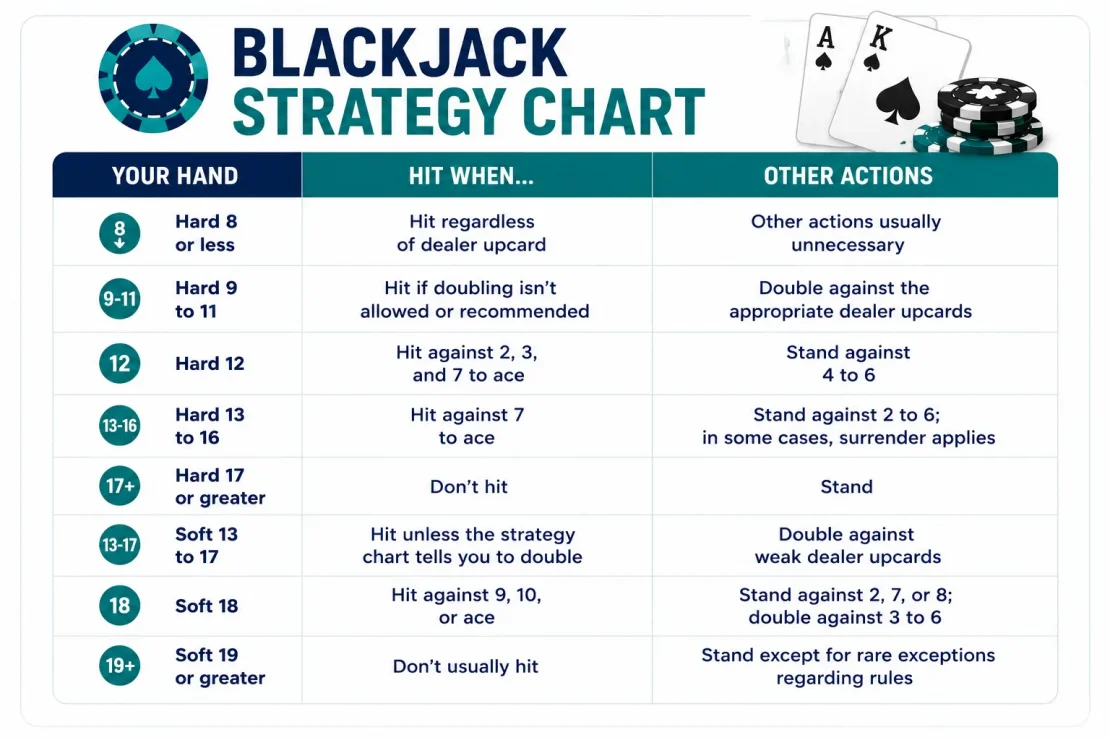
The hard hand does not include an ace at all or an ace, which has to be treated as 1 point only to save the player from busting. Hard 8 and lower hands should be hit in most cases, as adding one card will not make the player’s total exceed 21 points. Those, who have to brush up on counting cards in blackjack, can check our guide to blackjack card values. The hard hand of 9 points may become a good choice to double rather than to take one more card.
In a popular multiple-deck version of the game, the hand of 9 points is usually doubled against the dealer’s 3, 4, 5 and 6 and is hit against the rest of the upcards. 10 points are doubled against 2 to 9, and 11 points are usually doubled against 2 to 10. In case doubling is not an option, the hand is hit. The decision on hard 11 against a dealer’s ace depends on the table rules.
One of the most confusing hands is hard 12. In most cases, this hand is hit against 2, 3, 7, 8, 9, 10 and ace and is stood on against 4, 5 and 6. Hard 13 to 16 hands should be hit against 7 to ace and stood on against 2 to 6. A hard hand of 17 points and higher should not be hit according to basic strategy.
When Should One Hit a Soft Hand
As was mentioned, a soft hand is a hand that has an ace and which has the opportunity to count it as 1 or 11. Thus, for instance, having an ace and a 6 means having soft 17 since an ace initially counts as 11. If one gets a big card, one can make an ace 1 so that one would not lose. This makes a soft hand play more actively than hard with the same total value.
Totals 13 to 17 of soft hands are usually hit unless basic strategy says to double down with the help of the given soft hand against a weaker dealer’s upcard. If the possibility to double down is not possible, the player should just hit. So, for instance, soft 17 that consists of an ace and a 6 is doubled against certain dealer’s cards but is hit against other ones.
Soft 18 is the most complicated total since hitting, standing and doubling can be all correct. Under common rules, this hand is normally hit against dealer’s 9, 10 or ace, stood against 2, 7 or 8 and doubled against 3 to 6. However, if the player cannot double, it is better to stand rather than hit. Soft 19 and higher totals should be stood upon, but there are certain exceptions which are noted on the appropriate black jack cheat sheets.
When Should One Avoid Hitting?
If the total of a hard hand is 17 or higher, it is better to avoid hitting, as the possibility to bust is too high. Hard 17 can only be improved by drawing an ace, 2, 3 and 4, while 5 and more cause losing right away. Hard 18, 19 and 20 have even fewer safe cards. A player should not do anything about his or her blackjack hand because it is made of two best cards: ace and a 10-value one.
Some hard totals should not be hit when the dealer shows a weak card. In particular, hard 12 has to be stood against 4 to 6, and hard 13 to 16 has to be stood against 2 to 6. If the player takes another card, he or she risks going over 21 right away. By standing, the player allows the dealer to draw according to the table rules and possibly bust.
A hit is not the first action to be considered in all situations. For example, a pair of aces or 8s will most likely be split, while a pair of 10s will probably stand as a hard total of 20. Hard totals of 9, 10 and 11 may need to be doubled instead against certain dealer upcards, and the option of surrender might be available when having particularly weak hard totals of 15 and 16 against a strong dealer card. The specific order of actions is supposed to be derived from a strategy chart according to the rules of the table.
How Table Rules Impact the Decision
In some games, the dealer is obliged to hit or stand on soft 17. This rule affects the dealer, but it also impacts a few player’s strategy choices. The number of decks, the rules regarding the options of surrender and doubling might affect certain strategy decisions in the same way. A strategy recommendation made in a particular game might be slightly different in another due to table rules differences.
Every strategy chart is usually specified regarding its applicable conditions. Before choosing a strategy chart, make sure that it corresponds to the specific rule of the table you play at, especially when it comes to H17 or S17 tables and the availability of doubling down after splitting. If a particular chart advises doubling, but the table rules do not allow it, it might be necessary to choose a hit or a stand action instead.
How to Make a Hit Sign
In an online blackjack game, the player uses the Hit button and the card is dealt instantly. This decision cannot usually be changed, and live dealer tables work in a similar way. If no action is selected before the timer expires, the table rules determine the default action.
When playing at a physical table with face-up cards, the player is supposed to indicate the desire to receive additional cards by hitting the table with a finger. When playing a handheld game, the typical way of indicating such a decision is to scratch the edge of the cards toward the player’s side, leaving them on the table. The specific sign might differ from casino to casino, so the player has to follow the dealer’s instructions.
Points to Consider Before Playing
It is important to consider the natural blackjack payout, dealer soft 17 rule and the moves allowed to double down, split and surrender before joining a game. The above factors determine when hitting is the best move to make. Games can be compared using our selection of online blackjack casinos in New Zealand. Joining games from the lowest available stakes gives a player an opportunity to learn the rules.
More information about blackjack and casinos is available on DashTickets. Even though basic strategy may help one play wisely, it does not eliminate the house advantage or ensure that you win the game. Online casino gambling in New Zealand is restricted to people aged 18 or over, while the minimum age for gambling in land-based casinos is 20. Blackjack should be played using money that one is willing to lose.
Sophia Novakivska has already been spending 12 years on everything related to gambling writing. Slot and casino reviews, comparisons, top options for different audiences, news, how-tos and gambling history - she knows the area and proved it with her publications on Better Collective, AskGamblers and Gambling.com. For four years, Sophia is into NZ iGaming niche where she analyzes the online casino bonuses, live games, new slot releases, and sport news. Sophia’s credentials: GLI University’s iGaming testing & compliance course (2020) and UKGC-approved Responsible Gambling certification (2022).
Look at any online casino promotion wagering requirements attached to them, which are an important rule that dictates how many times a player must play through a bonus amount (or bonus + deposit) before they can withdraw any winnings. While they don’t make for the most engaging reading material, it is important to take note […]
Roulette is a game that looks, on paper, as though it actively invites strategy. As a player, you can cover individual numbers, colours, sections of the wheel, or combinations of outcomes. For as long as the game has existed, so-called betting systems have existed too, promising to control losses and capitalise on winning streaks. Unfortunately, […]
For some players, especially in New Zealand, the conveniences and delights of online casino gaming can develop into a fun pastime; for others, this fun can balloon into a bad habit that becomes difficult to crack. If it is getting increasingly hard to quit playing the online pokies, you are by no means in this […]

 Sophia Novakivska