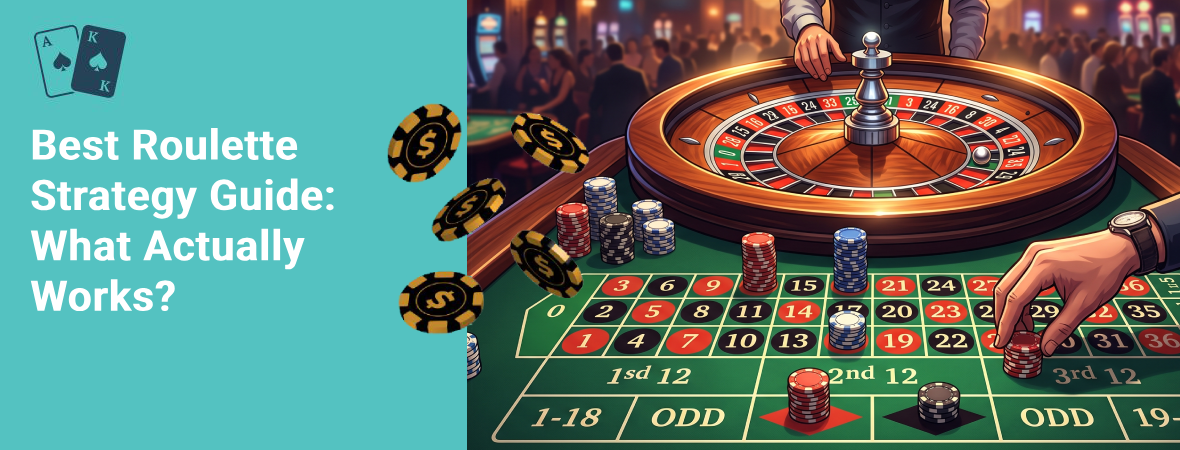
Roulette is a game that looks, on paper, as though it actively invites strategy. As a player, you can cover individual numbers, colours, sections of the wheel, or combinations of outcomes. For as long as the game has existed, so-called betting systems have existed too, promising to control losses and capitalise on winning streaks.
Unfortunately, the reality is a lot less glamorous: no betting pattern or strategy can predict where the ball will land or eliminate the casino’s mathematical advantage, known as the house edge. As a result, the best roulette strategy isn’t some secret number sequence but a practical one built around:
choosing the right roulette game for you
understanding the risks and payouts of each bet
controlling how much you stake per round
On this page, we are going to look at some of the ways you can improve your chances of winning while playing roulette without making unrealistic betting system claims.
Choose the Right Roulette Variant
When you’re playing online, there are three main types of roulette wheels you’ll come across, and choosing the right one is by far the most important strategic decision you can actually make. Below, we’ll walk you through the three most common types of wheels.
European Roulette
European roulette uses 37 pockets:
Numbers 1 to 36
One green zero
In almost every variation of the game, bets have a house edge of around 2.70%, which produces a theoretical RTP of 97.30%. That means, for example, that for every NZ$100 wagered, your theoretical average loss is approximately NZ$2.70, although, of course, the actual short-term results can be considerably higher or lower.
American Roulette
American Roulette is the worst of the three variants because it adds a second green pocket, the 00, bringing the wheel to a total of 38 pockets. That additional zero increases the standard house edge to around 5.26%, and that’s pretty significant, almost doubling the house edge when compared to playing the single-0 European version of the game. Unless there is a specific reason to choose it, American Roulette should usually be avoided.
French Roulette
French roulette also uses a single-zero wheel, but some games include player-friendly rules such as La Partage. Under the La Partage rules, half of an even-money bet is returned when the ball lands on zero, and this reduces the house edge on qualifying red or black, odd or even, and high or low bets to 1.35%.
Naturally, casinos are less inclined to offer French Roulette, but it is available at a fair number of online casinos in New Zealand. It’s worth taking a look and checking before choosing which wheel to bet on to see whether the French version is available.
Here’s an overview of the three games and their standard house edges:
Roulette Variant
Pockets
Standard House Edge
French with La Partage
37
1.35% on even-money bets
European
37
2.70%
American
38
5.26%
Inside and Outside Bets: What’s the Difference?
Roulette bets can, for the most part, be divided into two types: inside and outside wagers.
Inside Bets
Inside bets cover individual numbers or small combinations of numbers, and we’ll look at a few common examples below:
Bet
Numbers Covered
Standard Payout
Straight up
1
35:1
Split
2
17:1
Street
3
11:1
Corner
4
8:1
Six line
6
5:1
Inside bets are riskier compared to outside ones, but they can produce meaningfully larger wins, too. A NZ$1 straight-up bet on a single number, for example, returns NZ$35 in profit when it wins, and that’s not the kind of odds you’ll find with outside bets.
Outside Bets
Outside bets cover larger groups of numbers, offering either 2:1 or 3:1 payouts. These include:
Red or black
Odd or even
1-18 or 19-36
Dozens
Columns
Naturally, even-money bets win more frequently than those on individual numbers (and other inside bets). Interestingly, outside bets don’t have a lower house edge than inside bets on a standard European roulette wheel: they simply have lower volatility.
What is Flat Betting?
Flat betting means wagering the same amount on each spin rather than increasing or decreasing your stake depending on previous results, which is pretty much the polar opposite of most roulette systems and strategies.
For example, a player with a NZ$100 starting balance who plans to use flat betting may stake NZ$5 on red every spin – and this stake never changes, even if they win/lose 10 rounds in a row. Flat betting (like every “system”) is not a winning strategy, but it’s one of the more manageable roulette approaches because it keeps your exposure predictable, prevents you from recklessly increasing your stakes, and makes it easier to track your spending.
Does the Martingale Strategy Work?
The Martingale is probably the best-known roulette system, and it’s normally used with an even-money wager such as red or black. On paper, it’s very simple: the player places a bet, doubles it if they lose, and returns to their original bet after a win.
Assuming a starting stake of NZ$5, here’s how that would look over six losing hands.
Spin
Stake
Total at Risk
1
NZ$5
NZ$5
2
NZ$10
NZ$15
3
NZ$20
NZ$35
4
NZ$40
NZ$75
5
NZ$80
NZ$155
6
NZ$160
NZ$315
Now, the idea here is that a win at any time recoups your previous losses, but there’s a major catch – and one the table above doesn’t show. If you lose six hands, things can be manageable. But increase that loss to 8, 9, or 10 hands, and the total stake you need to wager increases to:
Losing Spin
Stake on That Spin
Total Lost
7
NZ$320
NZ$635
8
NZ$640
NZ$1,275
9
NZ$1,280
NZ$2,555
10
NZ$2,560
NZ$5,115
In other words, after losing ten spins, you would have risked NZ$5,115, and your next bet would need to be NZ$5,120 just to break even! If you had an unlimited bankroll, it would work – if there wasn’t the second catch: table limits. These limits are explicitly designed to prevent players from successfully using the Martingale strategy, so while it sounds nice on paper, in reality it doesn’t work and should be viewed as nothing more than a gimmicky idea.
Other Popular Roulette Systems
Fibonacci
The Fibonacci strategy uses the sequence:
1, 1, 2, 3, 5, 8, 13, 21...
After a loss, you move one step forward in the sequence, and after a win, you (usually) move back two steps. It’s designed to increase your financial exposure more slowly than the Martingale, but the same problem remains: previous losses don’t improve the probability of the following spin.
D’Alembert
Under the D’Alembert system, you add one betting unit after a loss and remove one unit after a win, so it’s a bit less aggressive than doubling, but it’s still heavily reliant on the idea that wins and losses will eventually balance out in a useful sequence.
Paroli
Paroli is a positive progression system: instead of increasing the stakes after losses, you increase them after wins. This is, on paper, designed to limit the damage caused by a losing streak, but later losses can still cause you to give up all of your profit in a very short space of time, and, like all systems, it’s unable to change the house edge.
How to Manage a Roulette Bankroll
While betting systems can’t successfully and consistently beat the roulette wheel, one of the things that is fully under your control is bankroll management. This can help prevent a short session from turning into an uncontrolled losing one. Here are a few tips to help you get started:
Set a Session Budget: Decide how much you’re willing to spend before you even deposit, and never use money that you need for rent, bills, food, or savings. Treat each deposit as though it’s already lost; anything else is a bonus.
Choose a Sensible Betting Unit: Divide your total deposit into enough units to withstand standard roulette volatility. For example, a total session budget of NZ$100 could be divided into NZ$2 stakes, giving you a minimum of 50 units.
Set a Time Limit: You’d be amazed how many roulette rounds you can play per hour online, and even low-stakes playing can add up quickly. Set a time limit; maybe 30 or 45 minutes – and ensure you take a break after, regardless of your performance at the table.
Never Chase Losses: Nobody likes losing – of course – but increasing stakes because you’re on a losing streak is one of the fastest ways to turn a small, manageable loss into a catastrophic one. Once you reach your session limit, walk away: if you are unable to do so, make sure to use responsible gambling tools like deposit and loss limits before you begin playing.
Final Thoughts: So, What Actually Works?
If you’ve made it this far, you’ll already know the honest answer: no betting system – not the Martingale, not the Fibonacci, not any type of “clever-sounding” wording- can ever overcome the house edge of a casino game, nor can any “system” predict where the ball will land. Every spin is 100% independent, and maths stays the same, regardless of how you bet.
That doesn’t mean you don’t have any power, though. There are a few things you can do, like picking the right wheel (French roulette where possible, and European roulette where not), understanding the different bets at the table, and controlling your stakes.
Ultimately, however, roulette is, and always will be, a game of chance, so treat it as entertainment rather than a way to make money. Choose French roulette where available, don’t bet more than you can afford, and walk away when your session is finished: that is, honestly, the best roulette strategy there is.
Alex Smith is the lead editor and writer at DashTickets, specializing in online casino and sports betting content for New Zealand players. With over 12 years of iGaming experience, including a tenure as Head of Editorial at Casinomeister, Alex is renowned for his accurate, fair, and player-first writing style. His in-depth reviews and guides provide clear, trustworthy information to help readers make confident decisions.
I was always fascinated about casino dealers: usually, they are nice young girls and handsome guys with a smile on their faces who are willing to entertain players around-the-clock. This is why I decided to study the topic of what it takes to be a dealer and how much they earn. According to this webpage, […]
Baccarat is often described as a game of pure chance, and to a large extent, that’s true! There’s no hand to worry about optimising, no cards to hold or fold, and no moment where any “skill” comes into play. But, “no playing strategy” doesn’t mean “no strategy at all.” See, the best baccarat strategy isn’t […]
Within the gambling gaming world at gaming casinos, you will be hearing one term more often: RTP. Quite simply, this acronym stands for Return to Player. Return to Player, or more shortly RTP, depicts the general percentage of all wagers that any particular casino game will pay out to players over time. For example, if […]

 Alex Smith