One of the few casino games in which your actions can make a difference in the long run is blackjack. It does not mean there is any foolproof system to earn money. It means you can avoid losing your cash unnecessarily by choosing the right table, doing the mathematically optimal play, and managing your cash exposure. Optimal play in blackjack consists of several elements, among which basic strategy, rule selection, and bankroll management are crucial.
Perfect play does not guarantee winning each and every session. Short term results of your session depend on cards you get, but the strategy comes into play when dealing with many hands to minimize mistakes and avoid the worst outcomes. The goal of the perfect strategy is to be efficient in your decision making, not predict future cards.
Select the Table First
Many gamblers pay attention to the minimum stake first. A smarter strategy would be to review the rules, because two similar tables can have completely different house edges due to rules’ differences. Most important of all is the rule about the payouts for natural blackjack. A 3:2 table pays 1.5 units to one, whereas a 6:5 table only pays 1.2 units. This 0.3-unit difference adds around 1.4 percentage points to the house edge, which is enough to cancel almost all advantages of the basic strategy.
Action on soft 17 is another factor. A table on which the dealer stands on soft 17 gives more chances to the player than a table with hitting on soft 17. Doubling after split, late surrender, and looser doubling rules are useful too. You will find more information about the soft 17 in our guide.
Before making the bets, check the information block of the selected table to find out about the payoff, deck count, soft 17 rule, possibility of late surrender and splitting. This takes only a minute but is more useful than all the progressive betting systems.
Using a Strategy Chart According to the Table’s Rules
Basic strategy is the list of actions having the maximum expected value for every combination of cards. This chart was built on the basis of statistical analysis of the results of all possible combinations of cards. Basic strategy does not give you an opportunity to win this particular game but gives you the best choice in playing this hand.
The chart differs depending on the table. The six-deck chart varies according to the dealer’s rule – whether he stands on soft 17 or hits. The European rule “no hole card” also has influence on doubles and splits, as in that case the dealer can reveal blackjack after players have doubled or split and take those additional bets. Using charts is an integral part of the best blackjack strategy.
Common Blackjack Decisions
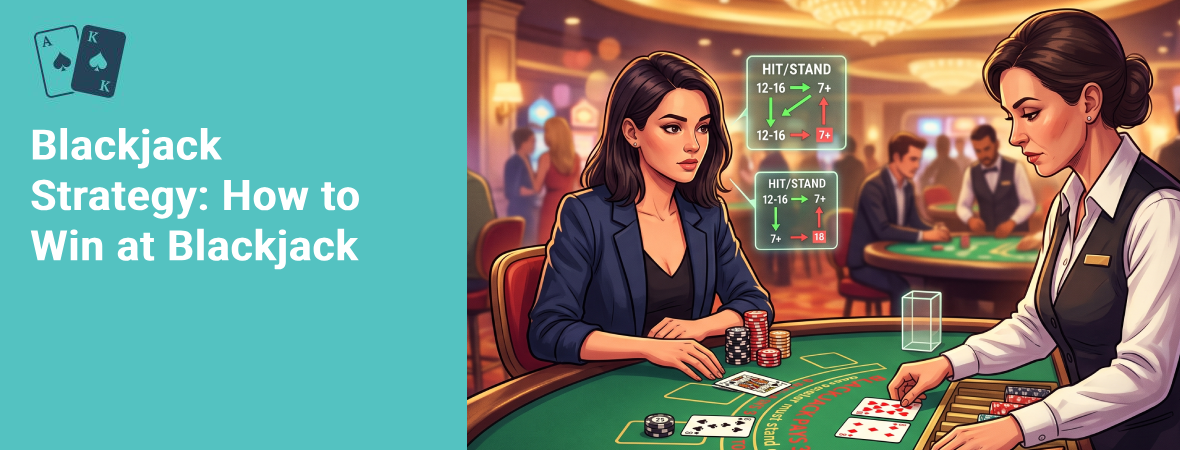
You do not have to know all the decisions at once. First, try to avoid making the most frequent mistakes. In a popular multi-deck game hard 12 is stood against dealer 4, 5 or 6 and hit against any other cards. Hard 16 is stood against dealer cards 2 through 6 and hit against 7 or higher cards. Sometimes surrender is made against some dealer’s strong cards. It may be rather difficult to remember these decisions, but the aim of this move is not improving the hand but choosing the action with the maximum expected value.
In the case of soft hand, another way of playing is offered. An ace can become 1 and change the total of the hand. For instance, soft 18 does not mean standing in all the cases. You can double your hand against some weak cards of the dealer and hit the hand against dealer cards 9, 10 or ace. If somebody cannot distinguish between hard and soft totals, we recommend reading our guide to blackjack card values first.
Decisions about pairs can also cause errors. Aces and eights are normally split, tens stay untouched and fives are considered to be a hard 10 rather than split.
Do Not Insure Your Hands and Place Extra Costly Bets
The term insurance suggests some kind of protection. However, it is a side bet that pays out in case the hidden card is worth ten. Without having accurate data about the rest of the shoe, you will not be able to see the real odds and make an informed choice. A basic strategy player should not buy insurance.
Side bets such as Perfect Pairs and 21+3 might bring decent payoffs, but in most cases, they have a higher house edge than the main hand. Thus, playing according to basic strategy in the main game does not mean you are playing the right way, if you constantly place additional wagers.
Card counting can influence your decisions about insurance in a shoe-dealt game. This is a special case when using insurance makes sense, not an argument to take it all the time. You can read our guide How to Count Cards in Blackjack to learn more about the method. For the vast majority of RNG games, there is no shoe to follow after reshuffle.
Keep Your Bets Constant
Increasing or decreasing your bet does not affect the chance to get a favorable outcome in the next hand. Double-up after losing the previous rounds, raise your bet because you feel luck coming, or place one big bet for recovery changes the size of the swings, but does not change anything about the cards.
To survive in the session, you should have enough units to make correct doubles and splits. It is better to divide your session budget into at least fifty bets rather than to have money only for ten. It allows you to estimate how close you are to sticking to the initial plan.
Decide on the maximal budget of the session before you start playing and do not consider your losses as something to recover. Stop-losses and winnings limits do not influence the house edge, but prevent the session from becoming a wild one.
Pay Attention to Playing Speed
Blackjack online can produce many more hands in one hour compared to a busy live table. The faster play makes you subject to the house edge. The expected loss can be calculated by multiplying the average bet, the number of hands and the house edge. With 10 units as an average bet, 100 hands and 0.5% of the house edge, the theoretical loss amounts to approximately five units. In the case of 300 hands, these numbers will give you 15 units.
This formula does not tell you about your next session – your outcomes may be totally different. This is the reason why table rules, bet size and playing speed should be viewed in connection with each other. The bad 6:5 table, accompanied by side bets and high pace, may get you into debt much faster than you expected.
Take enough time for recognizing what kind of hand you have, what is the dealer’s card and consulting the proper chart. A slow but right decision is worth more than a quick but wrong one. You should take a break in case you find yourself ignoring the chart, changing stakes on impulse or trying to win back some loss.
Treat Casino Bonuses with Caution
A casino bonus may give you additional money, but it does not mean that it increases the value of the game. Table games may count for your wagering contribution lower, some blackjack variations may not be included, maximum bet rules may apply. Read the terms of the promotion before taking part in it.
The table should be chosen due to its rules. The lesser bonus with a 3:2 game may turn out to be better than the larger bonus connected with 6:5 blackjack or difficult wagering requirements. The promotional value is important in case the game contribution, bet limits and withdrawal terms allow using the offer.
Winning at Blackjack – Can It Really Be Done?
One can win particular rounds or sessions, but there is no method that guarantees profitability in the long run. The most effective blackjack strategy minimizes the house edge and prevents mistakes which might worsen it. Choose the 3:2 payoff, select favorable rules, apply the corresponding basic strategy table, refuse insurance unless you have information about the count, do not play unfavorable side bets and do not change the size of your bet.
It is less exciting, obviously, than playing according to the method which ensures easy wins for sure, but more helpful. Blackjack is a game which is rewarding accuracy, not prediction. One cannot influence the next card, but one can influence the table he plays on, his actions and his betting size. It is where the real value of the game lies.
Sophia Novakivska has already been spending 12 years on everything related to gambling writing. Slot and casino reviews, comparisons, top options for different audiences, news, how-tos and gambling history - she knows the area and proved it with her publications on Better Collective, AskGamblers and Gambling.com. For four years, Sophia is into NZ iGaming niche where she analyzes the online casino bonuses, live games, new slot releases, and sport news. Sophia’s credentials: GLI University’s iGaming testing & compliance course (2020) and UKGC-approved Responsible Gambling certification (2022).
The casino industry has always had a sense of… let’s say mystique – and if you picture flashing lights, busy gaming floors, and wealthy people playing poker and baccarat – you’re not as far off as you might think! What’s more, now gambling is much closer, and everyone is able to play online in NZ […]
Card counting is one of the most talked about strategies in casino gambling, and it has been glamorised a lot by Hollywood. It’s feared by pit bosses, and it is misunderstood by pretty much just about everybody else! Now, the reality of card counting is a lot less sexy than Rain Man suggests, but the […]
Online pokies are one of the most popular forms of online gambling in New Zealand, but they’re also associated with a lot of confusion, misconceptions, and, sometimes, outright myths! Some players, for example, assume all online pokies are rigged, while others automatically think they’re safer than land-based pokies, simply because they’re digital. The truth? As […]

 Sophia Novakivska