
Understanding the Gambling Act 2003: Key Provisions
 Sophia Novakivska |
  Alex Smith
If you’re a player based in New Zealand, then you may be a bit confused with how legislation actually works. The truth is, for many years, New Zealand has been a bit of a grey-area zone – and there hasn’t (until now) been a domestic licensing framework regulating online gambling – although that’s about to change.
Up until now, the only legislation that was in place was the Gambling Act 2003 – and even with the new online gambling framework, it’s still very relvant today.
On this page, I’ll walk you through a breakdown of the Gambling Act 2003 and look at what it actually contains.
What the Gambling Act of 2003 Does: Main Purpose
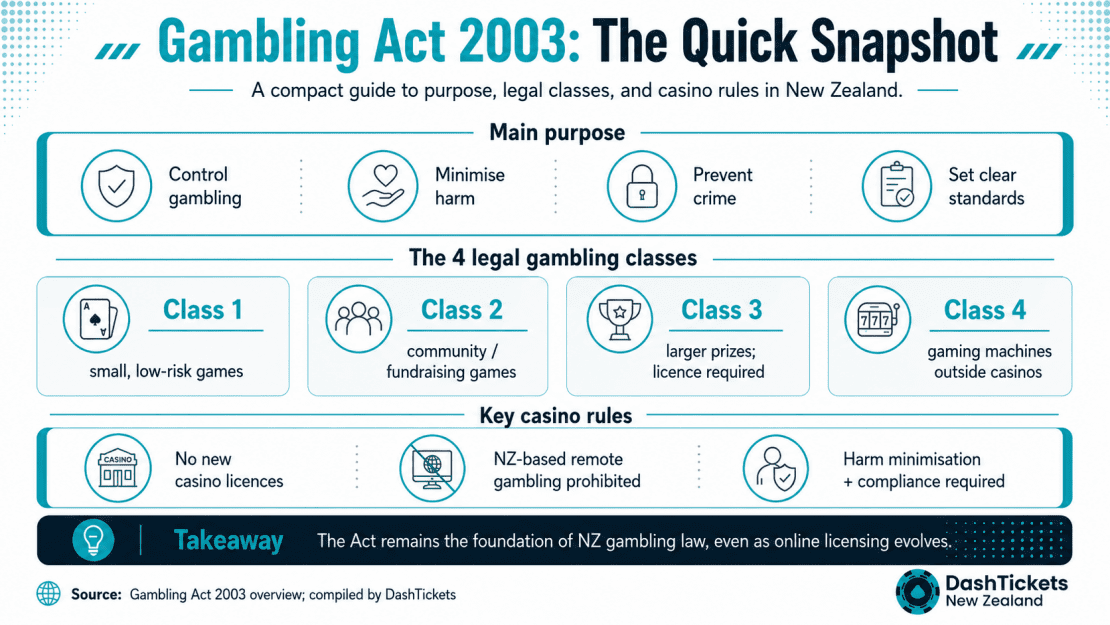
At its core, the Gambling Act 2003 is designed to control gambling in New Zealand, reduce gambling-related harm, and keep the industry as fair and transparent as possible, while ensuring that gambling proceeds can benefit the wider community as a whole rather than just operators.
The Act sets out New Zealand’s main gambling framework and it explains what types of gambling are permitted, who can offer them, when a licensor should be required, and what obligations operators must meet.
Now, the main principles are pretty straightforward:
– gambling should be controlled
– harm should be minimised
– crime and dishonesty should be prevented
– operators should be held to clear standards
For players, the Act is also important because it shapes how land-based casinos, gaming machines, lotteries, and other gambling activities are regulated. It also provides the legal foundation for later rules, licence conditions, and enforcement action.
The Four Classes of Legal Gambling
New Zealand divides most non-casino gambling into four classes, and these are mainly based on the size of the prizes and the level of risk that’s involved.
Class 1 and Class 2 gambling tends to cover smaller-scale activities – think low-value raffles and social fundraising games. Class 3 gambling involves larger prizes and usually requires operators to hold a license, while Class 4 gambling is the category most frequently linked with the gaming machines you’d see in pubs and clubs.
Interestingly, land-based casinos sit outside of this four-class license structure, and require their own casino licenses. That matters quite a lot, because casino gambling is treated – by law – as a high-risk activity, with stricter controls around things like responsible gambling, sustainability, venue operation, and game fairness.
Key Provisions of the Act for Casinos
For casinos, the Gambling Act 2003 is basically the main legal framework for land-based casino regulation in New Zealand, and it covers everything from licensing and operational obligations, to compliance standards and the powers that are available to regulators – if and when something goes wrong.
Below, I’ll walk you through some of the main provisions of the Act:
No New Casino Licences
The Act effectively freezes the number of land-based casino venues in New Zealand, because no new casino venue licenses can be granted under the Gambling Act of 2003 – although existing licenses are allowed to be renewed.Now, what this means for land-based casinos in New Zealand is that it’s not really just a matter of market demand.
New Zealand has – very deliberately – limited the number of brick-and-mortar casinos, with a policy that’s clearly focused on control, harm minimisation, and regulatory oversight.
Prohibition of Remote Interactive Gambling
The Gambling Act 2003 also banned remote interactive gambling that was carried out from New Zealand – but, crucially, this was subject to some limited exceptions, which is basically what allowed Kiwis to gamble online provided they were playing at offshore sites.
For years, this created an unusual situation: online casinos could not legally be based in New Zealand, but many Kiwi players still accessed offshore casino sites. That gap is one of the reasons New Zealand has moved toward a separate domestic online casino licensing framework, that’s being dealt with as of now (early 2026) under the Online Casino Gambling Act.
This new framework is designed to allow selected online casino operators into a regulated domestic system – with licensing, consumer protections, and harm-minimilisation requirements being a core part of the Act.
Mandatory Harm Minimisation Rules
Harm minimisation is one of the main purposes of the Gambling Act 2003, and casino operators and other gambling providers are expected to take pretty active steps to identify – and reduce – gambling-related harm.
In reality, this can include things like staff training, problem gambling procedures, self-exclusion options, and intervention processes. It also lays out standards for record keeping and clear policies for dealing with risky gambling behaviour.
Establishes Licensing and Compliance Frameworks
The Act also sets out who can be licensed, what standards they need to meet, and how gambling activities are actually monitored in day-to-day life.
For casinos, for example, this includes checks around:
- operator suitability
- game integrity
- financial controls
- venue operation
- ongoing compliance
It also gives regulators the ability to investigate or audit and, where necessary, take action in cases where licence conditions or legal requirements haven’t been met.
The Act’s Relevance in the Online Era
Now, where it gets pretty interesting is that the Gambling Act 2003 was written before online casino gambling had become anywhere near as common and popular as it is today. As a result, its treatment of remote online gambling has become one of the most important areas of reform for the New Zealand government.
The original position was pretty restrictive, and New Zealand-based remote gambling websites were generally prohibited. As a result, many players turned to using offshore sites, and that ended up leaving a gap between what the law controlled domestically and what Kiwi players were actually doing online.
As I mentioned earlier, New Zealand is currently in the stage of moving to a new domestic online casino licensing framework, which is set out under the Online Casino Gambling Act 2026. Interestingly, however, this new act includes the 2003 Act and instead builds on the same underlying principles that focus around harm minimisation, integrity, player protection, and regulatory accountability.
DIA, The Commission, And Ongoing Oversight
The Department of Internal Affairs is the main day-to-day gambling regulator in New Zealand, and it monitors all forms of gambling activity, investigates potential breaches – and has the power to enforce action where necessary.
The Gambling Commission has a separate role as an independent decision-maker, and they’re mainly involved in areas like choosing which operators to issue licenses to, and approve games and various certifications.
DIA and the Commission both have different roles on paper, but they work closely – and together, they give the Act what it needs to have real enforcement structure and accountability.
Conclusion and What’s Next
The Gambling Act 2003 remains the foundation of New Zealand’s gambling regulation, and it controls, essentially, how can actually offer gambling – how land-based casinos are licensed – how non-casino gambling is actually classified – and what operators are required to do in order to reduce harm and offer responsible gambling services to players.
Here at DashTickets, we’ve been monitoring the licensing situation in New Zealand very closely – and the upcoming domestic online casino licensing framework is a pretty dramatic change, and is one that’s going to shake-up the industry a lot.Still, even with these changes, the direction is still consistent with the 2003 Act’s core purpose – which is that gambling should always be controlled, transparent, accountable – and subject to clear safeguards for players and the wider NZ community.
Gambling should only ever be viewed as a form of fun; entertainment, and never a way to make money, or for financial gain. If you find yourself chasing losses, unable to stop, or expecting to win, you may be exhibiting signs of problem gambling. If, at any point, you feel that you have a gambling problem, stop immediately, check out our Responsible Gambling page, and reach out to organisations and charities like New Zealand’s Problem Gambling Foundation. Help and support is available.


Our New Zealand-based reviewers and editorial team, trusted by 12,000 visitors, test 4 online casinos per week. The reviewers, including Edward Howarth, Mark Dash, Sophia Novakivska, thoroughly test each casino as mystery shoppers who actually deposit money into the casino and then report back on what their experience was like from the player's perspective. Our ratings are based on the testers' experiences as well as diligent research of the casino background, the legal terms and conditions, and the reputation among New Zealand players, in compliance with Gambling Act of 2003. Our DashScore provides a comprehensive evaluation of each casino we tested. Our reviews comply with the Gambling Act of 2003 ensuring legal reliability.
This website uses affiliate links which may earn a commission for registrations and/or player activity at no additional cost to the player. We ensure affiliate links do not influence our rankings or reviews, maintaining our commitment to providing truthful content to our readers. Our affiliate links support our unbiased reviews, ensuring we provide genuine insights to our readers.
While we may earn commissions from brands listed on this website, our reviewers' unedited opinions, based on first-hand experiences, are always their own and are not influenced by the financial aspect in any way. Our Kiwi Experts review the brands from the player's perspective and present their own opinions. This allows us to publish objective, unbiased and true reviews.
Online casinos mentioned on this website allow players aged 20 and over to gamble. For New Zealand players, legal gambling age is 20, as enforced by the Gambling Act of 2003 and its amendments. Fine can be up to NZ$500 for persons caught underage gambling. If you are visiting us from another country, you are expected to obey the local laws regarding legal gambling age.
All our content is reviewed by a certified expert at least quarterly. We update data on terms and conditions, regulation, bonuses, payment systems, reread our content, make corrections and update pages. So you can be sure you are receiving up-to-date data on our website.