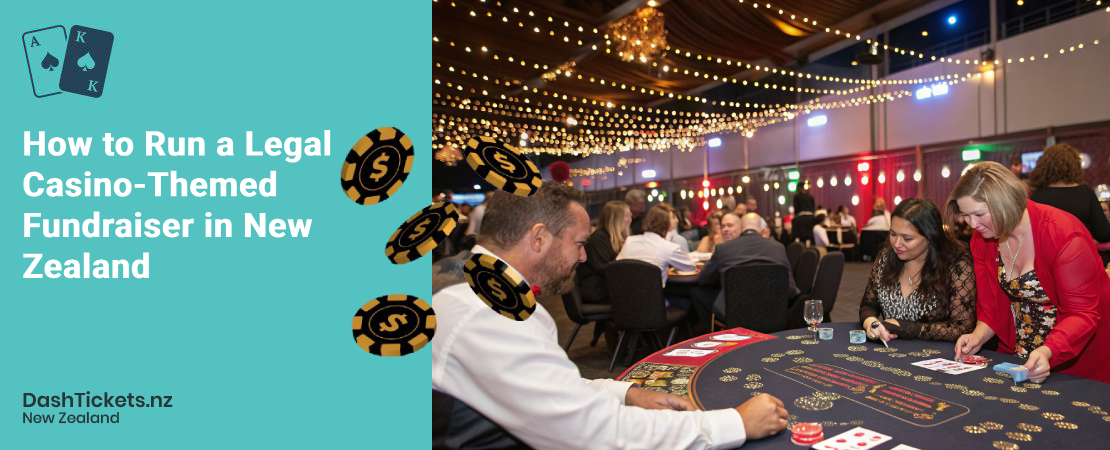
A casino night is the perfect fundraiser: it’s fun, it’s social, it’s easy to theme, and it’s likely to be popular enough to generate decent ticket sales. The thing is, in New Zealand, the minute you add a bit of chance, some prizes, and some cash, you are in a regulated environment. “It’s only for charity” does not take you out of that environment.
The aim is to encourage organisers to proceed with a little bit of planning to ensure the activity is on the right side of the rules, and a Vegas night can be organised in a manner that appears genuine, raises funds, and is legal in NZ.
The following guide walks through casino fundraisers: when they turn into “gambling,” how to structure tickets and prizes, and how to keep both the regulator and the audience comfortable.
Why Casino-Themed Nights Need Extra Thought
New Zealand gambling laws are based upon products where the following three elements coexist: the stake of a value, chance to determine an outcome, and the possible winning of a prize. You could turn a casino table with play money into one of those products if you are not careful how you design the table.
Added to that, the Act views gambling for profit and gambling for the purpose of the community in vastly different ways. The second category is where fundraisers will fall, but they are also bound by rules regarding prizes, turnover limits and class restrictions. One glance at an outline of how NZ gambling law works will give you a grounding in the basics to begin planning the function.
When A Casino Night Becomes “Gambling” In NZ Law
Under the Gambling Act, it is the mechanics and not the decor that is important. Where individuals put up hard cash at a table, engage in a game of pure or significant chance, and receive cash and or prizes in return, you are in the realm of gambling and not entertainment.
Community fund-raising will tend to fall into lower gambling “classes” and various levels of total prizes and turnover allowed. But if you begin to drift above those levels, or indeed resemble a credible casino and not a fund-raising night out, the area of licensing and a more adult form of the concept of licensed online casinos and casino operations will be closer to hand.
For a more detailed look, consider examining a plain-English summary of the Gambling Act 2003. You don’t need to take up a career in the legal profession, but a basic grasp of the Act’s concern for the minimisation of harm and “authorised purposes” will make it easier to distinguish where the casino fundraiser fits in.
Prize Structures And Ticketing That Stay Onside
The best way to maintain the legality of a casino fundraiser is to separate “gameplay” from the funds you are raising. The typical pattern is: guests purchase an entry ticket, the entry ticket comes with a package of play chips, and the chips are simply for entertainment purposes at the gaming tables. Once the chips are inside, nobody is allowed to purchase chips with cash.
The prizes are then awarded in a way that resembles a lottery more than a cash-out cage. For instance, everyone can receive a draw in a prize lottery based on their final chip stacks, or the top chip stacks go into a hat for the bigger prizes. The important thing to understand is that people are not buying chances directly with real cash while playing.
Since NZ laws take into account the total value of the prizes, it becomes important to ensure that a clear prize pool is established and remains below the class value threshold. However, you should still be able to make the competition a significant occasion through sponsored prizes and rewards, while keeping very large cash prizes out of the picture to avoid the more regulated class.
Play Money, Chips And Sponsorship Instead Of Cash Betting
If you are taking cash payments at the table for each hand, you are probably engaged in illegal gambling activities. Using play chips that cannot be exchanged for cash, in conjunction with a one-ticket entrance price, removes the legal risk from the equation. Your guests experience the thrill of “betting,” but you are not running a casino.
Sponsorship and donations are the way to go here. Local businesses may sponsor a table and donate prizes in kind. Players will purchase tickets, purchase additional chances to win in the raffle, and make a straight donation, but they will not be buying chips when they actually sit down to play. The difference is simple: cash at the door and not cash at the table.
You can make life simpler for yourself by incorporating honesty into your marketing strategy. Instead of “one night only charity casino,” consider “casino-themed fundraising night” to give it a glamorous touch while distancing the campaign from real gambling and huge wins associated with a commercial casino.
Age Limits, Venue Rules And Responsible Messaging
Even if what you are doing is classed as low-level gambling, the harm minimisation principles should be followed anyway. It is usually best to ensure casino fundraisers are only for people 18 plus if there are casino-style games and alcohol involved.
The responsible messaging in gambling doesn’t need to be too heavy. A short note on tickets, a presentation at the beginning of the evening, and a verbal reminder that it’s play money and you are not “winning back losses,” in most instances, will be enough. But if you do find yourself in a position of pointing people in the direction of the real thing later on, for example by mentioning the safest online casino options for adults, make it an informative, non-promotional tool.
Venue rules should also be considered. There may be venue rules regarding gambling-style events, particularly where the venue has its own gaming machines or liquor licences at stake. You should make the rules clear in writing before securing the date to avoid a surprise if a venue manager has an issue with a particular type of game design.
Typical Blunders In Charity Casino Nights
The first and most prevalent blunder is to allow the purchase of chips to occur again and again throughout the night. It simply doesn’t seem to be a problem – “it’s for a good cause” – but in regulatory terms it looks a lot like unlicensed gambling activity. The more real cash in the casino setting, the less plausible it is to claim it’s themed entertainment.
Then there is the issue of prize creep. The fund-raising teams add a “just one more” large prize, take a couple of sponsorship deals, and before long the combined prizes are pushing the limit for their category. It is much easier to limit the prizes and treat any additional sponsorship as a straight contribution to the cause and not part of the jackpot.
Lastly, organisers can forget that online activities also matter. If you begin live streaming the events, incorporating side games through applications, or connecting people to digital raffles, make sure that those elements fall in the same regulatory category and do not put you into the space of providing remote gambling services.
A Practical Checklist For NZ Organisers
Before you begin printing out tickets or lining up a band, it is a good idea to go through a short checklist in simple terms. This in no way constitutes legal advice but will keep most community groups out of obvious danger:
Is all real money exchanged at the door (tickets, donations, raffles), and not at the tables.
Are the chips definitely play-only, with no cash value and no topping-up through the night.
Is the total prize pool within the class threshold, with proof of how you arrived at the calculation.
Are prizes awarded through draw systems, and not through cashing in chips at a bank.
Is the event marketed as themed entertainment and not a real casino.
Are age restrictions, venue restrictions, and a basic message of harm minimisation in place.
For a wider perspective on regulated gambling operations for adults, in particular the web-based variety, an impartial guide from dashtickets.nz will provide a useful point of comparison. This will assist in gaining a better perspective regarding where your one-off fundraiser stands in comparison to commercial operations and why the regulators establish their respective lines.
Run well, a casino fundraiser brings a party, not a legal issue, to mind. The aims of the Gambling Act should be taken, in effect, as a design specification and not an inhibition to be hurdled. When the framework is in place, the casino kit of chips, green baize, and funny money will do its job: give the guests a night to remember and raise genuine funds for a worthy cause.
Sophia Novakivska has 10 years of experience in online gambling. For the past decade, Kyiv-trained linguist Sophia Novakivska has analysed everything from slot algorithms to live-dealer probabilities. Her bylines appear on Better Collective, AskGamblers and Gambling.com, and she specialises in NZ bonus clauses, slot maths and live-game odds. Sophia’s credentials include GLI University’s iGaming testing & compliance course (2020) and UKGC-approved Responsible Gambling certification (2022).
Alex Smith is the lead editor and writer at DashTickets, specializing in online casino and sports betting content for New Zealand players. With over 12 years of iGaming experience, including a tenure as Head of Editorial at Casinomeister, Alex is renowned for his accurate, fair, and player-first writing style. His in-depth reviews and guides provide clear, trustworthy information to help readers make confident decisions.
In New Zealand, roulette is loved by Kiwis for one simple reason: it is a game that has nothing to do with math and strategy is involved. It involves excitement and unpredictability and this is what gives Kiwis an adrenaline rush. The game was said to be invented by Blaise Pascal in the 17th century […]
Access at gambling facilities is not often mentioned in the promotional literature, but it is what will determine whether people get to gamble at all. For the disabled gambler, the difference between “nice idea” and “real option” is often the difference between ramps, signs, lighting, and the level of listening. However, the problem also exists […]
If you have been following my blog for quite some time, you know that I know a lot about top-rated New Zealand gambling sites and their promotions. Having extra cash in my account always makes me stoked because with casino’s funds you can play a chocka of games with better winning chances. I bet you […]