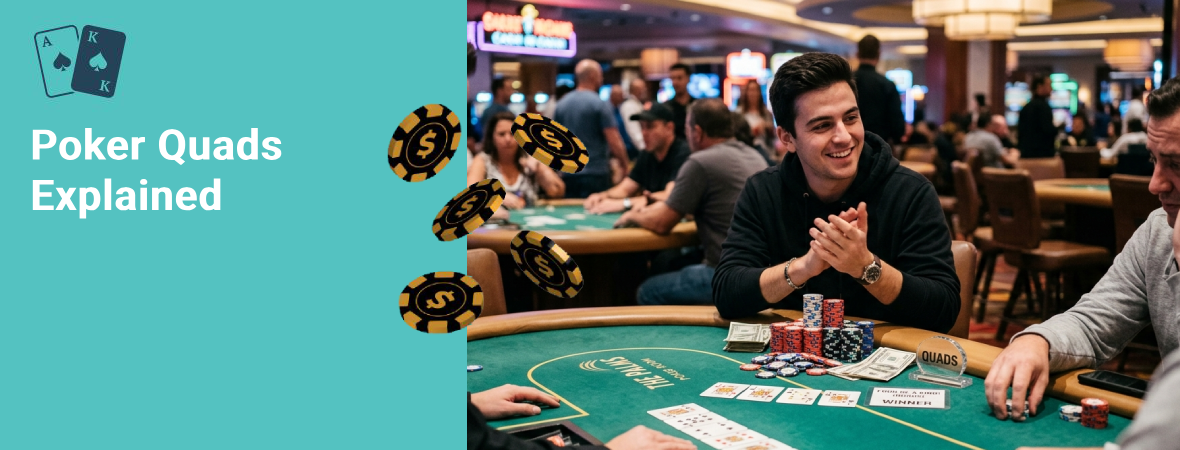
Quads is poker slang for four of a kind – and that means four cards of the same rank, like four Kings, or four nines. It’s one of the rarest and strongest hands in poker, and it almost never loses – but understanding how to play quads isn’t as easy as you might think, given its rarity!
On this page, we’re going to look at exactly how quads work – and what you need to know about this rare and unusual hand-type!
What Counts as “Quads?”
The definition of quads in poker is actually pretty simple, and it just refers to four cards of a single rank, regardless of suit. In Texas Hold’em, this usually comes from a combination of your hole cards and the community cards.
For example, you might hold a pair of jacks, and if two other jacks land on the board, you have a four-of-a-kind hand; quads!
Now, as Texas Hold’em is based around making the best five-card hand possible, you do technically have a kicker when you hold quads, although this almost never matters for determining the winner.
The only time when it would, is if the four-of-a-kind is on the board itself, in which the player with the highest card in their hole cards wins.
Where Quads Ranks in the Hand Hierarchy
From strongest to weakest, the standard poker hand ranking is:
Royal flush
Straight flush
Four of a kind (quads)
Full house
Flush
Straight
Three of a kind
Two pair
One pair
High card
Now, it’s worth remembering that not all quads are the same. While it’s insanely rare for two players to hold different quads, it is possible – and they’re ranked from card ranking: low-to-high. So, quad 10s is a more powerful hand than quad 8s.
How Rare Is It?
In a standard 52-card deck dealt as a five-card poker hand, the odds of being dealt four of a kind are approximately 1 in 4,165. In Texas Hold’em, where you’re working with seven cards total (two hole cards plus five community cards) to make your best five-card hand, the odds actually change a bit: flopping quads while holding a pocket pair, for example, happens roughly 1 in 416 times.
Making a four-of-a-kind in any other way remains a very rare event, and it’s a strong enough hand that you can never assume a player holds a better hand than you: the only real question is how you maximise getting paid!
How to Play Quads
The biggest challenge when it comes to playing quads isn’t strategy in the normal sense. You’re almost never going to fold a four-of-a-kind, and you’re almost never behind with the hand, either. The biggest issue is expecting value – and whether you can extract much value depends mainly on the board.
If you hold a pocket pair and form quads on the flop or the turn, you have a much better chance of stacking an opponent with a strong hand than you would if there is a three-of-a-kind already on the board.
If you flop quads on a dry, unconnected board, betting hard immediately often just gets you called by nothing or folds out anything that isn’t already beat, while checking – or making a small bet – can keep weaker hands in the pot longer, allowing you to try and build value over multiple streets instead of just one.
If the board pairs in a way that gives opponents a plausible full house or flush, they’re far more likely to pay off bets – sometimes, pretty big ones – because they genuinely think they’re ahead, or close to it. In these situations, betting sooner, for value, tends to make more sense than slow-paying, since your opponents actually have a real hand to call with.
The only thing you ever really need to watch out for with quads is the unusual case where the board shows four to a flush or four to a straight in the same suit. This is the only time you could feasibly be against a straight flush – but even then, four-of-a-kind is a very difficult hand to throw away.
Quads in Other Types of Poker
In Omaha, where players use exactly two of their four hole cards – along with three community cards – four-of-a-kind hands appear a lot more frequently than in Hold’em, simply because players are holding more cards. As a result, there are many more potential combinations – and this changes value-betting dynamics a little bit because your opponents are more likely to also be holding strong, well-connected hands.
In Seven Card Stud, things change even more, as quads can be made entirely from a player’s own cards! This also makes things more unpredictable as there’s no shared board (community cards) that give away information like in Hold’em!
The Bottom Line
Quads – four of a kind – is one of poker’s true premium hands, and it ranks just below a straight flush, beating every other hand – full house included. It’s a hand rare enough that most players will remember each time they have one – and the real skill with quads isn’t actually playing the hand, it’s figuring out how much money you can extract from it!
Alex Smith is the lead editor and writer at DashTickets, specializing in online casino and sports betting content for New Zealand players. With over 12 years of iGaming experience, including a tenure as Head of Editorial at Casinomeister, Alex is renowned for his accurate, fair, and player-first writing style. His in-depth reviews and guides provide clear, trustworthy information to help readers make confident decisions.
In terms of goal setting and profitability, blackjack is a great game where the target is to get a sum of 21 points without busting. What is more, the house edge in blackjack becomes incredibly low if players apply basic strategy correctly. Nevertheless, seasoned casino goers want something exciting along with the game that will […]
If you’ve ever walked through a casino or pub in New Zealand, there’s a fair chance that the raucous clanking of pokie machines has filled the air. They are a part of Kiwi nightlife, the source of the possibility of instant excitement and the hope of an unexpected windfall. Online casinos are constantly providing bonuses, […]
Trust is one of the biggest concerns for online casino players in New Zealand today. Whether you’re spinning the reels of your favourite pokie, or placing bets on your favourite casino table game, betting online means you can’t physically see the cards, dice, or pokie machine mechanics at work. Essentially, you’re relying entirely on software […]

 Alex Smith