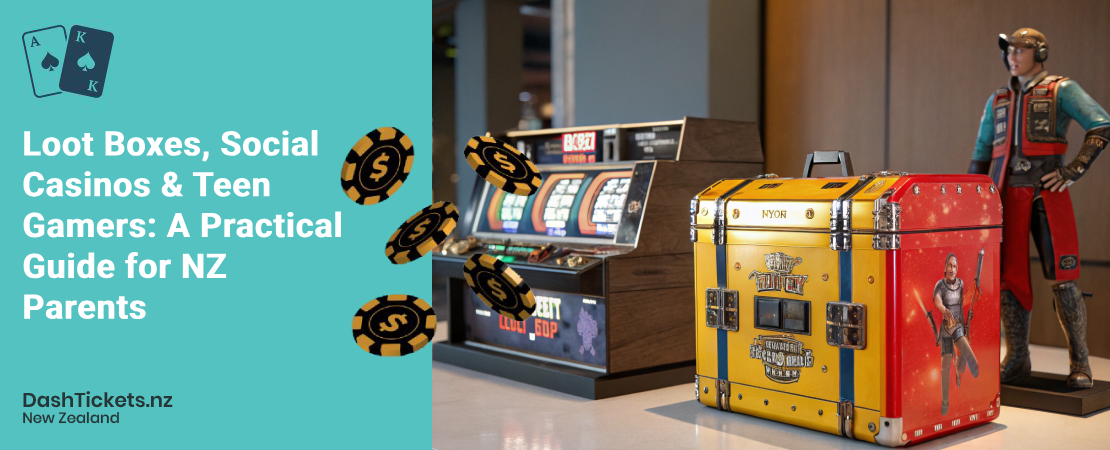
Most NZ parents spent their childhood with cartridges and arcade machines, not apps where you buy “gems” priced at 10.99 per pack. The way current games mix the lines between pure gaming and gambling-style components is hard to notice if you are not in that environment daily.
Loot boxes, skin-betting, and social casino games exist in a grey area in terms of their classification. They don’t tend to include the word “gambling” in the name, but they use many of the same psychological elements. This guide tries to explain how and why they function in similar ways to gambling and what a parent in New Zealand can do if they suspect their child is engaging with these mechanics.
Loot Boxes, Skins Betting, Social Casinos
Loot boxes are packs in a video game that consumers purchase but do not know what they will be getting. A teenager may purchase a box hoping to get a rare gun, skin, or card, but mostly they will receive normal things in this process. Instead of money for a clear product, a chance is being traded.
Skins betting goes even further. For instance, in some games, cosmetic items commonly known as “skins” are traded in the marketplace available through a third-party platform. The cosmetic items acquire value and serve the purpose of gambling chips to bet on a match or a simple game. It gives the experience of gambling with the items in the game while having the prospect of real-life consequences.
Social casino games refer to casino-style games where virtual chips are applied in lieu of cash. The social casino games include games such as slots, roulette, and blackjack. To adults, social casinos actually constitute a full-fledged product category, and you can take a look at how social casinos function in real life because they are designed for adults and not teens.
Why These Mechanics Feel Like Gambling
All three fall into the same basic pattern found in gambling. The player puts in a stake of value, receives a partially random outcome, and experiences a rush when the result is rare and large. The fact that the reward is virtual has little effect on how the brain responds.
Design perpetuates this cycle. Loot boxes feature lights, sounds and “near-miss” animation sequences when a prized item narrowly misses landing. Social casino apps reward large wins with a shower of coins. The psychological kick is similar to that of a pokie machine, despite a different regulatory status.
“Soft” expenditures also make it difficult to distinguish between them. Teens usually make purchases with stored value cards, gift cards, and in-game credits. The absence of physically handling cash makes it easier to misjudge what has really been spent, especially in prolonged sessions and events that encourage the “one more” purchase.
How These Habits Can Shape Later Gambling Behaviour
Expenditure in loot boxes and social casino games will not in and of itself produce a problem gambler. It will, however, help normalise a number of ideas. The first is the notion that paying for a chance is simply a form of entertainment. The second is the notion of “chasing a good outcome” through a little extra cash when things are going poorly.
When the teenager encounters a real-money sports betting site or casino in the future, the pattern will be recognisable: “Deposit, spin, open packs, chase the big win.” The danger can seem lower than it really is because the pattern feels like something they have “always done” in games.
Then there is the mood piece. If loot boxes and social casino applications become the default way of coping with stress, boredom, and anxiety, the pattern can easily transfer into adult gambling, even if the content changes. The emotional experience is much the same.
New Zealand, UK, And EU – Where The Law Stands
Within the New Zealand context, loot boxes and social casinos sit largely outside traditional gambling legislation. The Gambling Act 2003 aims to target instances in which money is wagered in order to win cash, as well as funds convertible to cash. Most in-game purchases fall short of this definition, even if the activity feels gambling-like.
The current policy remains “watch and research” instead of “ban and regulate.” The UK has considered loot boxes a risk to youth but has stopped short of classifying them fully as gambling.
Several countries in the EU have taken an even tougher line against loot boxes. Belgium and the Netherlands have taken action against particular loot box systems they see as too similar to gambling. There are ongoing debates in other countries regarding how to limit the issue.
For parents looking for a structural understanding of the NZ landscape – and where “offshore” services begin and end in terms of local law – a plain-English guide to how NZ law treats local vs offshore operators is a useful starting point.
Practical Settings Parents Can Change Today
The first defence mechanism is basic payment control. For smartphone, tablet, and console devices, password/PIN entry can be required for each payment, stored payment details can be removed, and in-app payments can be restricted or blocked. The “tap to buy” feature turns into a deliberate action in this manner.
Most popular platforms allow the creation of family accounts and child accounts with restrictions based upon age and content filters to restrict access to certain applications and limit allowed play time.
It is also important to review settings in games that offer them. Some titles allow the number of loot box notifications to be reduced or “promo” pop-up notifications to be turned off, so limited-time offers no longer appear on the lock screen.
Conversations To Have With Teens
Controls are helpful, but teens will eventually be confronted with such mechanics somewhere. Open discussion is better than hoping they will never appear.
The important points are simple: most of the funds put into loot boxes and social casino chips are meant to remain there, in the same way a casino works. There is a big difference between paying for a specific game or skin and placing a bet with a low chance of paying off.
Identifying the tricks by name also has benefits. Limited-time offers, reward bonuses for consecutive actions, and near-miss experiences are all designed into the system intentionally. When teens can name these tactics, they are better able to recognise pressure as part of the system and not as a sign that they “must” spend.
Forewarning Signals To Be Wary Of
Despite the presence of guardrails, some adolescents will press against the boundaries. One instance of a loot box purchase is not an emergency, but a pattern of red flags requires attention.
Typical red flags include:
unexplained credit card or app-store charges
sudden changes around devices and gaming hours
anger or panic in response to restrictions on games and spending
talking about “getting even” with a game after losing items or chips
schoolwork, sleep or sports dropping off while screen time rises
None of these indicators alone proves a gambling issue, but together they imply that the activity is getting out of emotional proportion: entertainment, escape, and identity combined. That is where rational talk and possibly outside support are needed.
Where To Find Accurate Adult Context
Lots of parents feel like they are playing catch-up with what their teens are doing. The best way to put the gap into perspective is to first understand how gambling is conducted for adults and then notice what kids are copying from those systems. DashTickets has informative pages on gambling in New Zealand, online casinos and responsible gambling that provide that perspective in a neutral way and are not trying to sell anything.
From there, you can establish rules for your family – no loot boxes, cosmetic purchases only, or linking in-game purchases to chores and budget discussions. The point is that the rules should be based on a clear understanding of how those systems function, not just on a gut sense that “games are different now.”
Loot boxes, skin-betting, and social casino games are not going anywhere anytime soon. The aim is not zero risk, but informed use instead. Using a combination of settings, open dialogue, and a little bit of background information, parents in New Zealand can stay in the know without needing to be experts in the first place.
Sophia Novakivska has 10 years of experience in online gambling. For the past decade, Kyiv-trained linguist Sophia Novakivska has analysed everything from slot algorithms to live-dealer probabilities. Her bylines appear on Better Collective, AskGamblers and Gambling.com, and she specialises in NZ bonus clauses, slot maths and live-game odds. Sophia’s credentials include GLI University’s iGaming testing & compliance course (2020) and UKGC-approved Responsible Gambling certification (2022).
A former professional poker player turned data guru, Mark Dash has devoted the past 16 years to decoding the numbers behind New Zealand’s online-casino scene. A PGDipJ graduate of Massey University, he now heads our analytics team, where he rates NZ casino sites, audits bonus conditions and models RTP performance. Mark’s expertise is reinforced by advanced training in gambling statistics and responsible-gaming practices.
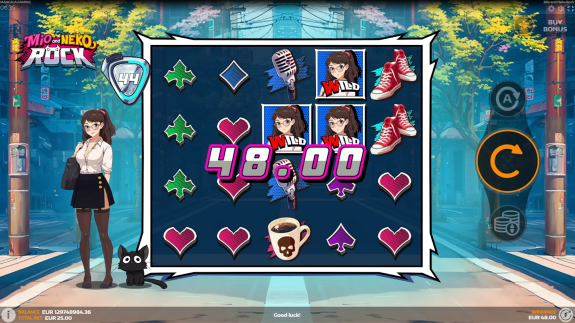
Now, let’s talk about the freshest, quirkiest, most energetic Mio & Neko Rock slots there are, brought by Mancala Gaming. Be it anime enthusiasts or lovers of feature-packed games, this slot will have something for all kinds. Take your virtual guitar, and let’s jump into details. First Impressions: A Rocking Theme Picture this: Mio, who […]
Let’s dive into this slot from Mancala Gaming, GemBlitz Bonanza, which simply drops the traditional and exchanges it with something different-refreshingly new. Imagine the wonder one gets from setting foot inside an arcade world complete with gems, mystery, and enough progressive jackpots to leave an individual breathless. At this point, if you have an avid […]
We have gathered a list of popular gambling streamers and players, and checked how many subscribers they have, in order to rank their popularity and understand the demand for gambling in general. Name Kick Youtube Instagram Twitter Twitch Trainwreckstv 289 K Adin Ross 1.25 million Roshtein 256 K 133 K 1 million xQc 735 K […]