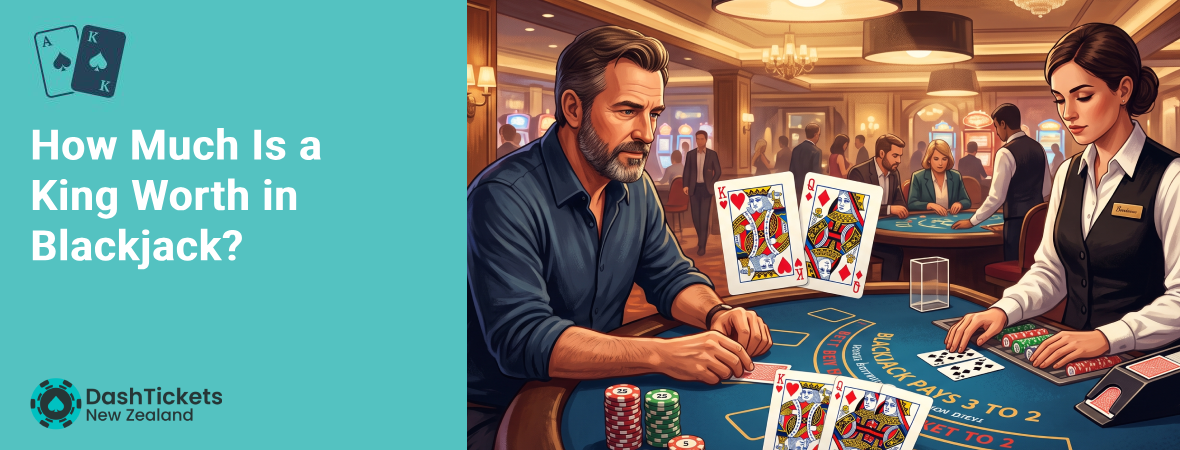
A King is worth 10 points in blackjack, and so is the Queen, the Jack and the 10 itself. The suit doesn’t matter whatsoever: the King of hearts and the King of clubs score identically, and no standard blackjack game pays anything extra for drawing a specific suit on the main bet.
Unlike the Ace, which switches between 1 and 11 depending on which helps your hand more, the King has one fixed value that never moves. That makes it the easiest card in the deck to read and the one doing the most work behind the scenes.
A Total of 16 Cards Versus Four
Because the 10, Jack, Queen and King all are worth 10,, a 52-card deck contains 16 10-value cards in total. This equates to 30.8% of the deck, and every other rank is represented by just four cards, equating to 7.7%.
That difference is what drives pretty much every decision you’ll end up making at the blackjack table, and it’s why the dealer busts so often when they show a 5 or a 6. It’s also why basic strategy tells you to hit 16 against a 10, even if the move feels very unlikely to win. And, it’s also why the “assume the dealer has a ten in the hole” habit exists at all.
King Versus Ace:
A King alongside an Ace is a natural blackjack: 21 on any two cards. It beats any dealer 21 (assuming their hand is formed from three or more cards), and you can expect to land a natural blackjack roughly once in every 21 hands.
Now, what you get paid for a blackjack is the main thing to check before you sit down at the table. A normal table pays 3:2, so a NZ$10 stake would return in winnings of NZ$15.
Some blackjack tables, however, use a 6:5 payout structure instead, which, in the above example, would return NZ$12 in winnings instead. That NZ$3 difference doesn’t sound like much until you convert it: the 6:5 payout structure increases blackjack’s house edge by around 1.39%, which is more than 300% that of the regular game, played with basic strategy.
Takeaway: Always look for tables that pay 3:2 for a natural blackjack, and avoid ones that pay 6:5 where possible.
Never Split Kings – With One Exception
Two Kings gives you a hand total worth 20, and that means it’ll end up winning around 70% of hands it plays. Splitting turns that into two hands starting from 10 apiece, each of which needs to improve just to reach where you already were.
Players are most tempted to split tens when the dealer shows a 5 or 6, on the logic that the dealer is likely to bust anyway. Yes, that logic makes sense, but it’s still wrong: you’re trading a very near-certain result for two, what are essentially, gambles.
The only exception to this rule is when card counting. In a very high true count against a dealer 5 or 6, splitting tens turns positive because the shoe is loaded with the cards that are more likely to make both hands into two 20s, but this is a complex situation and not part of any blackjack basic strategy guide.
What to do When the Dealer’s Up-Card is a King
A dealer showing a ten-value card busts about 21% of the time, and when you compare that against roughly 42% on a 5 or 6, you start to see why it’s so important to hit in the first place when you’re holding 15 or 16 against a picture card.
It also explains why insurance loses money. Insurance pays 2:1 and needs the hole card to be a ten. With your two cards and the dealer’s Ace visible, 49 cards are not yet seen, and only 16 of them are ten-value – which equates to 32.7%.
You need 33.3% just to break even, so you should never take insurance, and, when the dealer does show a King, play according to basic strategy.
The Bottom Line
A King is always worth 10 in blackjack, and this means that it has exactly the same value as a Queen, Jack or 10, regardless of its suit. Unlike an Ace, its value never changes, either.
What makes the King important isn’t the card itself, but the fact that it’s one of 16 ten-value cards in a standard deck. That unusually high concentration affects everything from the dealer’s chances of busting out, to why you should never split a pair of Kings – and, also, why a 3:2 blackjack table is considerably better value than one paying 6:5.
So, if all you came here to find out was how much a King is worth, the answer is simple: 10 points.
Alex Smith is the lead editor and writer at DashTickets, specializing in online casino and sports betting content for New Zealand players. With over 12 years of iGaming experience, including a tenure as Head of Editorial at Casinomeister, Alex is renowned for his accurate, fair, and player-first writing style. His in-depth reviews and guides provide clear, trustworthy information to help readers make confident decisions.
Are you wondering why there is an article advising you on how to stop gambling pokies on the largest casino blogging website in New Zealand DashTickets? It’s because we want to draw a clear line between gambling for fun or as a hobby and a gambling addiction. The government of New Zealand takes responsible gaming […]
Trust is one of the biggest concerns for online casino players in New Zealand today. Whether you’re spinning the reels of your favourite pokie, or placing bets on your favourite casino table game, betting online means you can’t physically see the cards, dice, or pokie machine mechanics at work. Essentially, you’re relying entirely on software […]
Quads is poker slang for four of a kind – and that means four cards of the same rank, like four Kings, or four nines. It’s one of the rarest and strongest hands in poker, and it almost never loses – but understanding how to play quads isn’t as easy as you might think, given […]

 Alex Smith