New Zealand and Australia share a corner of the globe and a set of rugby codes and quarrel over pavlova origin. As for online gambling, however, they merely share a superficial resemblance at first sight. Beneath the surface is a world marked by substantially divergent behaviour and products.
Both offer pokie machines and betting on racing and lotteries as well as internet betting. Both talk about responsible gambling and harm minimisation policies. However, Australian gamblers on average lose more than New Zealand gamblers, and more Australian losses come from pokie machines at pubs and clubs than New Zealand losses.
To understand why the profiles vary so widely, it is important to examine where the money actually goes and how different products are regulated.
How Much Do People Really Lose?
The four main gambling industries in New Zealand – Lotto NZ, TAB racing and sports betting, non-casino gaming machines, and casinos – between them generate several billion dollars a year from gamblers’ losses. On a per capita basis, this represents several hundred dollars a year for each person. In recent years, actual per-head spending is around the low NZD hundreds, with losses divided across non-casino gaming machines, lotteries, casinos and TAB betting rather than being dominated by a single product.
The number is still impressive for a small nation, and it is dwarfed by that of its neighbour. Australia leads the international ranking on the loss of gambling money. The loss for the whole country is estimated to be in the tens of billions annually, averaging over a thousand Australian dollars per person, with a particularly large per-capita share of that total coming from pub and club pokies and from betting products.
In general terms, Aussies on average lose about three times as much as New Zealanders once currency and population differences are taken into account. It is also important to note that the gap is driven by frequency and spend on particular products, not just how many people gamble, and especially by much higher per-person losses on pokies and betting in Australia than in New Zealand, while the per-capita gap for lotteries and casino play is smaller.
Where the Money Goes: Pokies, Betting, Casinos, Lotteries
In terms of New Zealand’s loss distribution, there is a fairly even spread for a small market. The biggest slice is taken by non-casino pokie machines at pubs and clubs, but lotteries and casinos are not far behind. TAB racing and sports betting represent the next biggest slice. Buying Lotto tickets and scratch tickets on a weekly basis, having a few spins on the machines and the odd visit to the casino would represent very typical behaviour.
In Australia, the losses are more focused. Analysis carried out on the Australian data has indicated that the majority of the losses occur through two channels: pokies and betting. The loss that occurs through the electronic gaming machines in pubs and clubs is responsible for close to half of total gambling losses.
This is largely due to availability. Australia has a remarkably high number of machines within suburbs. New Zealand does offer Class 4 machines within pubs and clubs, though far fewer than Australia and with stricter limits. For gamblers preferring online play, the equation leans differently again – towards offshore online casinos and local betting platforms.
Different Rules, Different Risks
New Zealand’s contemporary model is sustained by the Gambling Act 2003. The Act lists two objectives: preventing and reducing harm, and controlling the growth of gambling. It identifies four significant sectors and applies a national levy and public-health strategy across them.
In contrast, the Australian system deals with the regulation of gambling mainly at the state and territory levels. New South Wales, Victoria, Queensland and the others determine separately the conditions for machines, betting products, and gaming locations.
In recent times, Australia has introduced some national-scale frameworks on top of this patchwork system for online betting, including a central self-exclusion system that prevents access to all licensed online sports bookmakers at once. New Zealand is at a relatively nascent stage with regard to offshore interactive gambling, creating a gap between the framework for land-based establishments and online platforms accessed on mobile or desktop.
Pokies Culture: Pubs, Clubs and Screens
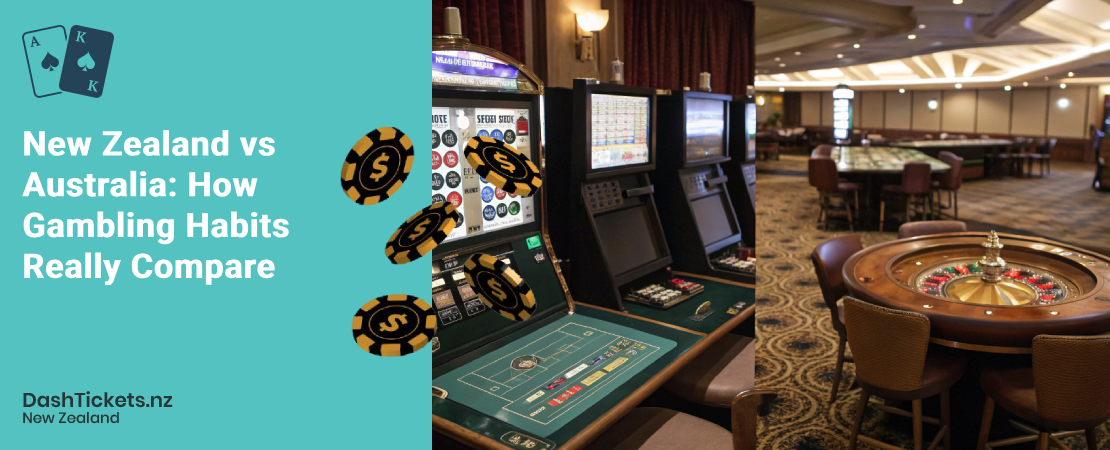
In Australia, pokie machines are incorporated seamlessly within social life. It is not unusual to find local clubs and pubs offering cheap meals and sports on television, with pokie machines stretching out as far as the eye can see. Such convenient access can lead to cumulatively high spending, and the pokies room becomes a convenient extension of the bar.
New Zealand has similar machines for pubs and clubs under the system referred to as Class 4 venues, although with fewer machines and greater public discussion over their locations. A great deal of public discourse centres on identifying which suburbs have the greatest number of machines and the community associations entitled to grants based on the profits made by such machines. For gamblers preferring to steer clear of such a background yet who still love their pokies, online pokies casinos emerge naturally.
In both nations, there is a gradual shift towards online gaming. Aussies mostly prefer placing bets on locally licensed online betting platforms. New Zealand players, on the other hand, often fall back on foreign platforms that run outside the harm reduction policies within New Zealand.
Lessons That New Zealand Can Learn from Australia
Despite all its troubles, Australia has gone further than New Zealand on specific harm minimisation instruments. For instance, pre-commitment on pokie machines, whereby one is able to set spending and time limits before play, is either already operational or being tightened in various states. Some Australian states are even adopting card-based schemes that can be readily enforced with strict limits.
In terms of online support, the national self-exclusion register provides individuals with easy access to exclude themselves from all online and telephone sports betting services at once. Such centralised solutions do not require individuals to deal with multiple accounts on dozens of services.
The take-aways for New Zealand are simple. Tools for limiting play work best if they can be used on multiple sites and products at once. Self-exclusion should be easy to initiate and hard to reverse. And products with high-intensity play like pokies and rapid online betting should be assessed as products that require safety features by default rather than as exceptions for people already suffering harm.
Lessons That Australia Can Learn from New Zealand
New Zealand provides a cleaner case for the gambling industry as one that is deliberately circumscribed and defined by the state, as opposed to one that grows until public pressure pushes for a corrective. The law considers gambling a public-health issue and bundles gambling with the national harm-prevention strategy.
Machine caps and licensing terms ensure that the number of pokies outside casinos is lower compared to many Australian states. Community and equity aspects such as the placement of pokie machines and the use of profits made from them come more prominently into play.
Australia might take some inspiration from this approach: more emphasis on a national strategy on harm from gambling that operates above state politics; a closer link between funding for harm reduction and gambling revenue; and a more cautious approach to the proliferation of machines through community life, instead of simply providing further entrenchment of existing patterns of play.
For gamblers wanting to play on the safe side of the market in either jurisdiction, sticking to well-regulated mobile casinos is one way to give the player more power over their actions.
Both Sides of the Tasman
New Zealand and Australia function on a different scale and with a different approach, though the dangers are much the same. Both offer easy access to fast-paced products and obscure offshore sites, and both therefore face harm from losses that build up quietly over time.
Looking at the figures available, Aussies at this time happen to be suffering more losses, especially on machines, though both countries share the same dilemma: how to allow gambling while limiting harm.
Looking at both systems, one thing is clear. Rules, machine numbers and harm-minimisation tools matter just as much as personal habits. If boundaries are stricter, then losses and harm can be limited. If gambling is allowed to seep further into pubs, neighbourhoods and screens without limits, then the figures grow quickly and are not easy to bring back down.
Sophia Novakivska has 10 years of experience in online gambling. For the past decade, Kyiv-trained linguist Sophia Novakivska has analysed everything from slot algorithms to live-dealer probabilities. Her bylines appear on Better Collective, AskGamblers and Gambling.com, and she specialises in NZ bonus clauses, slot maths and live-game odds. Sophia’s credentials include GLI University’s iGaming testing & compliance course (2020) and UKGC-approved Responsible Gambling certification (2022).
A former professional poker player turned data guru, Mark Dash has devoted the past 16 years to decoding the numbers behind New Zealand’s online-casino scene. A PGDipJ graduate of Massey University, he now heads our analytics team, where he rates NZ casino sites, audits bonus conditions and models RTP performance. Mark’s expertise is reinforced by advanced training in gambling statistics and responsible-gaming practices.
Have you heard of those deposit bonuses at online casinos and are wondering what is the deposit match bonus, how does it work, and do you really get the bonus money? This article will shed some light on the subject so you’ll be able to confidently claim the casino bonuses. For a quick fix and […]
If you’ve ever shuffled a deck of cards in your hand, you’ve wielded an element of technology unchanged in form for the last several hundred years. The passing down of this deck of 52 cards is, in fact, a tale of both global trade and advanced engineering. Most gamblers are only interested in what is […]
If you ever were inside a Kiwi pub or even casino, you could be sure you’ve already heard the jolly jingles going off of those pokie machines. Lively and flashing games haven’t become cultural characteristics for such a lot of years in a row from nothing, right? Recently there happened such a huge shift from […]