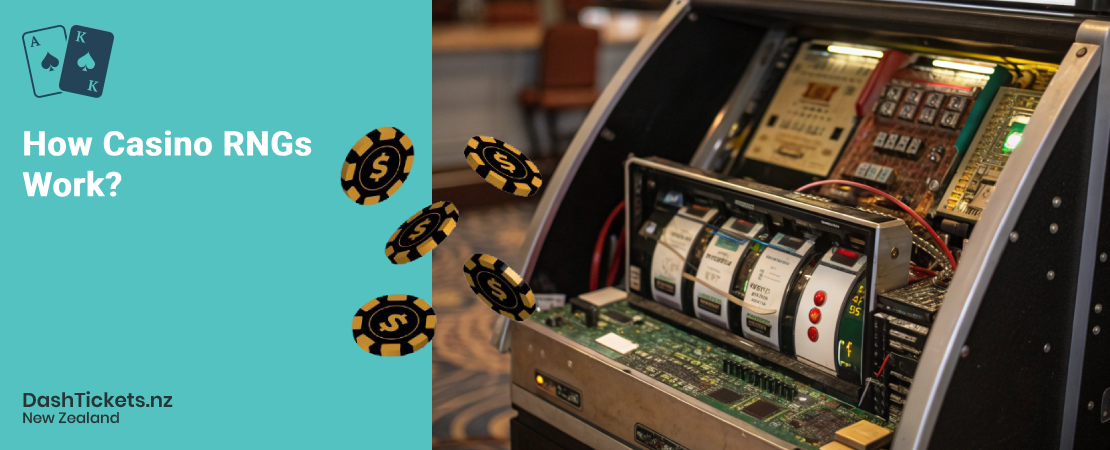
Each spin, each card deal, each roulette ball drop you watch online is a result that has been calculated in a rapid cycle running in the background. It looks like it’s all about luck, but it isn’t.
Only by understanding how casino RNGs work can you distinguish what constitutes fair play and what constitutes superstition. You do not need a math degree to understand this. You only need to know what happens the moment you hit Spin.
Why RNG Is at the Heart of Online Casinos
RNG is short for Random Number Generator. It is the engine behind all online gaming results. Online casinos would be predictable without RNGs.
In a physical casino, randomness stems from physical phenomena: the force of gravity acting on the ball, friction on the roulette wheel, or a human dealer handling the cards. In online gambling, this is no longer the case. That is where RNGs enter the scene with an endless sequence of numbers to produce an instantaneous result.
When you’re scouting the best pokie sites NZ for real money gaming, you’re making a choice that isn’t based on the coolest graphics. It’s a matter of the platform that you feel you can rely on. It isn’t the theme that matters; the engine is where the fairness is determined.
What “Random Number Generator” Really Means
Generally, there is a PRNG (Pseudo Random Number Generator) running within most online systems. Don’t be intimidated by the “pseudo” part of PRNG. It does not mean something is being produced that isn’t what it appears to be; it simply means that numbers aren’t generated through physical random noise.
The process begins with a seed number and produces a string of numbers. However, a good PRNG produces a string of numbers that is virtually unpredictable unless one is familiar with the internal state of the server. Players and casino employees never see these raw numbers, only the end result on the screen.
The Myth of “Timing” the Slot
One of the misconceptions is that you can time your spin in order to win. This is not possible because the RNG never rests or sleeps. It is always running continuously, producing thousands of outcomes every second, even if nobody is using it.
The game software catches the value at the precise moment of the click on the Spin button. If you had pushed the button a millisecond later, the outcome would have been entirely different. Since a human is not capable of reacting with such accuracy to the millisecond, the outcome is effectively random to the user.
From Numbers to Reels, Wheels, and Cards
The RNG supplies the numbers, but the game needs to make it resemble a slot machine, a wheel, or a deck. The “mapping” procedure is determined during the time the game is developed.
A specific value from the RNG results in a particular stop on the computerized reel. The program looks to a table to determine which symbol corresponds to that value. For example, a given RNG value might be mapped to ‘Cherry’ on reel one.
This mapping is hardcoded. The casino cannot wake up on Friday morning and decide to “tighten” the machine by adjusting the mapping. To do that, they would have to change the code and resubmit it for recertification.
If you want a closer inspection of the engine underneath the bonnet, there are dedicated guides for pokie machines explaining how pokies work, the internal mechanics of the system, and the payout formula.
Testing, Certificates, and Why Audits Matter
As you cannot see the code, you have to rely on independent auditors. The independent laboratories exist for checking the randomness of the RNG: eCOGRA, iTech Labs, and others.
These labs run simulated versions of millions of gameplay cycles. They determine whether the actual outcomes correlate with the theoretical mathematical model. They also make sure there isn’t cheating around edge cases, such as disconnections from the internet.
For a player from New Zealand, it is important to know who verifies these games. You can usually see explanations for these terms on review websites such as dashtickets.nz, which go into detail on how checks by eCOGRA or iTech Labs help ensure that it is the end-user who is protected. These checks help ensure that the RNG behaves randomly within its designed parameters.
RTP vs. Volatility: The RNG’s Control Levers
RNG outputs are random, but the overall game is not chaotic. It has limits imposed on it by the developers. These limits are determined by RTP (Return to Player) and volatility.
The RNG is the mechanism that produces outcomes. Over time, as enough spins are played, those outcomes tend to converge toward the game’s RTP. If the RTP is 96 percent, the results can swing above or below that mark in the short term before the totals stabilise over a very large number of spins.
Volatility is just the distribution of that payback. High volatility means long streaks of dead spins followed by occasional huge hits. Low volatility means small wins are produced more frequently. The randomness is the same; only the pattern of results is different.
Why Games Feel Hot, Cold, or “Rigged”
If it’s fair math, why does it sometimes feel obviously rigged? Because what you are seeing is variation. True randomness is spotty. It does not hand out winnings evenly throughout a given playing session; a perfectly smooth pattern is closer to a rigged game than a fair one.
A fair slot machine with average RTP can run for 100 spins without paying out anything significant and then pay out an enormous amount in one bonus round. Our human brain doesn’t like that. We remember the long dry stretch and decide it has “tightened up.”
When we are on a lucky streak, we believe the game is “hot.” Yet the RNG does not know it is hot. It cannot recall the previous play. It will keep rolling numbers all day long. “Rigged” is often nothing more than our brains trying to detect patterns in random noise.
Picking Safe Sites That Use Certified RNGs
This level of protection is not consistent across all casinos. The best policy is to stick with casinos that include games from reputable companies.
Major brands like NetEnt, Pragmatic Play, or Playtech have their reputations and licences. They would not jeopardise international approvals for a fixed spin at one client. When looking at different casinos, see how many of the major brands are in the lobby. That is your best practical guarantee.
If the site is not clear about its licence or is running unusual or proprietary games that leave no trail, then you should walk away. It may very well have a good RNG, but you would not be able to prove that. It is simpler to make your decision on the platform you choose rather than argue over “glitches” later down the line.
What Players Can Realistically Control
You cannot and should not audit the server-side code. The only aspects of the experience you can influence – and must influence – are game choice and bankroll management.
From a technological standpoint, to keep yourself safe, you play high-RTP games on audited websites. From a psychological standpoint, you protect yourself by recognising that winning and losing streaks are noise, not messages from the universe.
Knowledge of the mechanisms will not make you win, but it can reduce how much you lose through emotional tilting. When you grasp that every spin is nothing but an independent draw from the number stream, you are less likely to chase patterns that are not there and more likely to stop when you planned to stop.
Sophia Novakivska has 10 years of experience in online gambling. For the past decade, Kyiv-trained linguist Sophia Novakivska has analysed everything from slot algorithms to live-dealer probabilities. Her bylines appear on Better Collective, AskGamblers and Gambling.com, and she specialises in NZ bonus clauses, slot maths and live-game odds. Sophia’s credentials include GLI University’s iGaming testing & compliance course (2020) and UKGC-approved Responsible Gambling certification (2022).
A former professional poker player turned data guru, Mark Dash has devoted the past 16 years to decoding the numbers behind New Zealand’s online-casino scene. A PGDipJ graduate of Massey University, he now heads our analytics team, where he rates NZ casino sites, audits bonus conditions and models RTP performance. Mark’s expertise is reinforced by advanced training in gambling statistics and responsible-gaming practices.
Trust is one of the biggest concerns for online casino players in New Zealand today. Whether you’re spinning the reels of your favourite pokie, or placing bets on your favourite casino table game, betting online means you can’t physically see the cards, dice, or pokie machine mechanics at work. Essentially, you’re relying entirely on software […]
When one hears the word casino, visions of glittering lights and active tables are usually the immediate images. Behind the scenes, however, is a workforce of employees responsible for operating the slot machines to the security force. Casino careers are much more diversified than just dealing or spinning roulette wheels. Further, determining how much these […]
Suppose you’ve ever sat down at a baccarat table, or even watched a few rounds being played online. In that case, you’ve probably seen a wall of tiny red and blue circles flashing across a digital scoreboard. Those little dots, called roads, are what players use to track trends, streaks, and so-called patterns in the […]