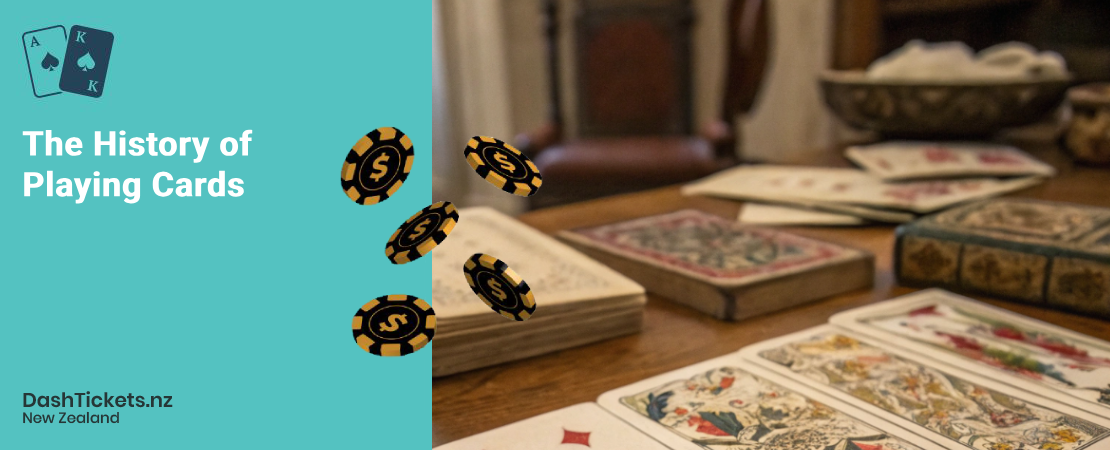
If you’ve ever shuffled a deck of cards in your hand, you’ve wielded an element of technology unchanged in form for the last several hundred years. The passing down of this deck of 52 cards is, in fact, a tale of both global trade and advanced engineering.
Most gamblers are only interested in what is in front of them. But to have any knowledge of the history of cards is to have knowledge of the history of probability in general. All modern forms of gaming are simply an evolution of how to distribute random results with paper and ink.
In today’s world, you can find the heirs to all these games at online casino reviews, where the traditional deck has been turned into code. But to put all this into perspective, we must start with where the first paper was shuffled.
Who Really Invented Playing Cards?
The general view of historians would lead to China in the 9th century during the Tang Dynasty. Although “playing cards” were not like what you would find on a poker table today, it was the start of trying to get away from cumbersome dice or tiles.
These Chinese playing cards were often referred to as “leaf games.” The leaf game is linked to woodblock printing. It was the first time in history that a game could be produced in large numbers, and this made gambling games accessible to everybody.
By the time the Ming Dynasty rolled around, the suit had already made an appearance. It was often based on values of money — coins, strings of coins, and myriads of strings. You were quite literally playing with money, and this established the psychological framework for the gambling that was to come for the next millennium.
The Islamic Bridge to Europe
Playing cards did not appear directly from China to London. They traveled through the Silk Road. By the 12th and 13th centuries, cards had arrived at the Mamluk Sultanate in Egypt. This is when cards began to resemble what we can see today.
In a Mamluk deck of cards, there were 52 cards and the suits included polo sticks, coins, swords, and cups. The cards lacked human figures due to religious restrictions; instead, they contained calligraphy designs.
As trade routes from Egypt to the Mediterranean were opened, the Italian and Spanish sailors brought the “Moorish” cards to Europe. In the late 1300s, cards were being played at all major port cities from Venice to Barcelona.
The French Revolution of the Deck
Whereas the Italians and Spanish retained the complex Mamluk suits, it was the French in the 1480s who developed the set you are using today. The suits were reduced to hearts, diamonds, clubs, and spades.
This was a huge engineering achievement in mass production. The French suit symbols are silhouettes. Compared to the Spanish illustrations, these are simple enough to be reproduced through stencils. This was a method of rapid, inexpensive, mass-scale replication, which is exactly what was needed in games that had to scale to a huge degree.
The French also contributed to the “Big Three” of a deck of cards: King, Queen, and Knave (Jack). The French Revolution led to a short-lived effort to replace the monarchy in playing cards with “Liberties” and “Equalities,” but this was vetoed by the players in favor of tradition. The kings were retained.
Modern Banking Meets Ancient Games
As the cards became standardized, so did the ways in which players paid for them. Today, the technology exists in a digital format. Players in the old days paid the house in actual gold or chips. Now, some online casinos that accept Neosurf use it simply as one of several payment options for those who prefer prepaid vouchers over cards or bank transfers.
The payment method has changed, but the structure of the games has not. Whether it is cash, chips, or a voucher balance, you are still staking value on the same familiar deck.
This transition to digital payments has enabled a transition of the card deck from a physical thing to software. You don’t need a dealer to shuffle; you need a random number generator to produce the same mathematical randomness provided by a 52-card pack.
The Divergence: Poker and Blackjack
The ancestor of all cards is the same, although the resulting uses as psychological tools are quite different. From the 1800s, the deck started to employ two functions: gambling with the establishment or gambling with other people.
Blackjack: a game of math and the house edge. Poker: a game of human psychology. These games are so different in skill level that they both use the same cards. Both blackjack and poker use 52 cards.
There are various theories about how the number of cards in a standard deck was decided to be 52. Some of them relate to the calendar: 52 cards as 52 weeks in a year, 4 suits as 4 seasons, 13 cards in each suit as 13 lunar cycles.
Whether this happened by design or was simply a stroke of luck with regard to game design, 52 happens to be a “mathematically perfect” number for a game like poker. 52 is large enough to accommodate millions of different hand combinations, and small enough to be held in one hand.
It is this balance that made “the French deck” so universal. Decks with different numbers of cards, such as 40 in “the Spanish deck” or 32 in “the German deck,” also exist, but none have achieved this global prominence.
The Move to Plastic and Pixels
In the 20th century, improvements were made to the material. We transitioned from paper cards, which lasted one night of heavy play, to cellulose acetate, then to plastic PVC. These types of “Kem” cards were washable and reusable thousands of times.
However, now we are completely beyond the physical. In an online casino, the “cards” are nothing more than graphical representations of numbers selected from an RNG. It doesn’t “know” it is playing a game with cards; it merely knows the chances of certain numbers being selected.
Nevertheless, the imagery is there. We continue to employ King, Spade, and Diamond as a worldwide visual language. Even within the 100% digital world, there is a requirement for a “snap” of a card and a “turn of a dealer’s hand,” so that there is a sensation of realism within the game.
Future Directions for the Deck
We are already witnessing the emergence of what has come to be known as “smart decks” at traditional land-based gambling establishments, where all the cards feature RFID. This enables the casino to track all wagers and movements of the cards in real time.
In the online world, the classic deck of 52 playing cards has resurfaced in live dealer games, where you are treated to views from high-definition cameras broadcasting images of a live dealer handling a physical deck. This constitutes a full-circle experience with communications technology so advanced it takes you back to the 9th-century process of pulling a piece of paper.
Whether it is on a smartphone app or a velvet table, you are part of a tradition which has survived wars, revolutions, and has adapted to technological change. A deck of cards is perhaps one of the most enduring pieces of game technology ever created.
The Deck: Why It Never Goes Out of Style
A brief history of playing cards is, of course, a story of people searching for ways to quantify luck. Whether it was paper money from the Tang Dynasty or more contemporary forms of digital blackjack, there is one constant. What we seek is a fair and unpredictable method of gauging our approach against luck.
The next time you lay out a deck of cards, remember that each suit and each face card is a legacy of a 1,000-year global adventure. It is a game system that has evolved through the input of millions of players — and it’s here to stay.
Sophia Novakivska has 10 years of experience in online gambling. For the past decade, Kyiv-trained linguist Sophia Novakivska has analysed everything from slot algorithms to live-dealer probabilities. Her bylines appear on Better Collective, AskGamblers and Gambling.com, and she specialises in NZ bonus clauses, slot maths and live-game odds. Sophia’s credentials include GLI University’s iGaming testing & compliance course (2020) and UKGC-approved Responsible Gambling certification (2022).
A former professional poker player turned data guru, Mark Dash has devoted the past 16 years to decoding the numbers behind New Zealand’s online-casino scene. A PGDipJ graduate of Massey University, he now heads our analytics team, where he rates NZ casino sites, audits bonus conditions and models RTP performance. Mark’s expertise is reinforced by advanced training in gambling statistics and responsible-gaming practices.
If you’ve ever sat at a blackjack table and been dealt a pair – like two 8s or two 9s – you’ve probably faced one of the most important (and misunderstood) decisions in the game: whether to split, or not to split. Knowing when to correctly split, from a mathematical perspective, can make a major […]
If you’ve been playing online slots for a while, you probably aren’t even aware that they are called 3D slots and that they’re creating an illusion that you’re playing a three-dimensional game. By now it’s no longer a defining trait, as when something achieves enough of a market penetration you don’t mention it anymore, but […]
In New Zealand, roulette is loved by Kiwis for one simple reason: it is a game that has nothing to do with math and strategy is involved. It involves excitement and unpredictability and this is what gives Kiwis an adrenaline rush. The game was said to be invented by Blaise Pascal in the 17th century […]