Live dealer game shows occupy a weird middle space somewhere in between a traditional casino and a TV studio. They are much more akin to prime time viewing than they are to a blackjack table, but beneath the glamour and lighthearted chatter lurks the ever-present house advantage. They act as a stepping stone into the live casino for a recreational player intimidated by traditional tables.
These games utilize wheels, dice towers, and bonus boards rather than cards and layouts. They are designed to be loud, fast-paced, and social, incorporating multipliers and side games for players in addition to basic wagers. How the mechanics operate for the best experience is the difference between “fun” and “good odds” that players must understand.
What Are Live Dealer Game Shows?
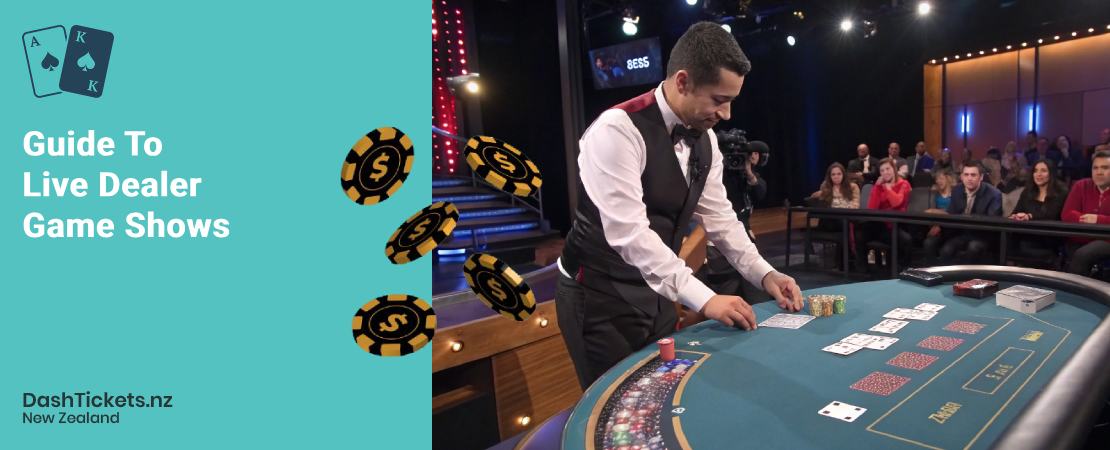
Live dealer game shows are live games played in the studio, broadcast on TV-like stages. The player has a host on one side, with a wheel/gameboard, explaining the gameplay and chatting with the live audience while the player makes bets on a limited set of results. This is more game-show-like than playing a solitary table game.
Examples of games that come under this category are Crazy Time, Monopoly Live, Deal or No Deal Live, Sweet Bonanza Candyland, and so on. They employ multipliers, random bonus games, and animated sequences to avoid the tedium and boredom of the original game. However, from the programming point of view, the underlying math model and the RTP table would still look the same as that of any other live casino game.
If you are looking for a more general idea of how these titles sit within the live market – with other titles including blackjack, roulette, and baccarat – then it is worthwhile to read a guide on real money live online casinos, and then specialise within that field for game shows.
How They Differ From Classic Live Tables
Classic live games involve a fixed rule set. In blackjack, there’s a known deck, distinct choices, and a minimal house edge if you play properly. In roulette, there’s a numbered wheel and consistent payoff terms. Once you grasp the fundamentals, there’s very little variance between each studio setup.
Game shows have a more fluid feel. The rounds are shorter, the graphics alter for each bonus round, and the host has a role that combines dealing and presenting. The core bets are often extremely simple – pick a number, a colour, or a segment – but the journey from bet to payoff can be complex.
This makes them much simpler to interpret at a glance. A new player can learn “bet on the wheel segment” quicker than one can learn optimal blackjack plays. However, the price for the additional elements of fun with random bonuses is that the return to player rate is generally lower than for sharp table games.
Money Wheels, AR Layers & Bonus Rounds
A majority of the live game shows feature a money wheel. In the money wheel, the segments are predetermined with numbers or bonus names/symbols. The host will spin the wheel, and the players who wagered on the winning segment receive payments based on the segment.
Apart from the basic wheel, producers involve augmented reality elements and additional gameplay. This is because in, for instance, Crazy Time, the basic wheel can initiate one of various side games, each of which has its own set of multipliers, mini-rules, and so on, that need to be followed. The other variants involve dice towers, walls, or ball draws based on the theme of Pachinko.
The AR layer places animated multipliers, ladders or bonus paths on top of the screen. This is like playing a video game on top of a physical wheel. This combination of real world technology and visual effects is what gives the game appeal, but each additional stage is still represented by the underlying maths, and the return is known before the game is even launched.
RTP: Game Shows Versus Blackjack And Roulette
Live game shows are not set up to compete with blackjack and low-edge roulette based purely on RTP. A good live blackjack game using proper strategy can put you somewhere around the 99 percent level. Even European roulette, with a single zero, can be found to be somewhere around the mid to high 97s depending on what bets you choose to ignore.
Game shows will normally rank lower. Taking into consideration the distribution of the wheel, the frequency of bonuses, and the max multipliers, most common games will have an RTP in the mid-90s. Certain wagers can dip lower, especially those with higher levels of risk and those that offer potentially huge rewards for just a tiny hit rate.
This does not make them “bad” games; it merely shifts their purpose. They are more entertainment items than grinding aids. For a person wanting to extend their bankroll while maintaining a small house edge, traditional blackjack or straightforward roulette bets might favourably compare to the most volatile game shows featured in subsections such as “Crazy Time and other money wheel games,” featured in more generalised descriptions of various online casino games.
Popular Live Game Show Formats
Each studio favours a slightly different approach, but all the major ones have a couple of templates. Money-wheel games like Crazy Time, Monopoly Live, Sweet Bonanza Candyland, or Adventures Beyond Wonderland all have the basic concept of a common spin, with some segments leading to bonus boards or mini-games.
Then there are the hybrid table game shows. PowerUP Roulette, to name one, begins in a conventional manner, with a roulette wheel, but eventually random PowerUP multipliers start being applied to certain numbers, building upwards over several games in a chain. Dice or boards, such as games like Boom City, may not utilise wheels to the same extent, but adhere to the same concept.
To get a feel for the level of variability that has developed, you might want to look at lists of Pragmatic Play live game shows that have been curated. You see the same concept emerge repeatedly for various themes. Wheels, multipliers, candy-board games, city map games or numbered balls—each one presented through a live show.
Bankroll, Session Length And Expectations
Given that live casino game show programs offer lower RTPs and are also very spotty, cash management becomes a factor that may mean more to players than in a slow blackjack game. Base wins happen in clumps, with a series of small base wins possibly offset by a weak period until a bonus round, which can then turn things around with one big win.
Short, fixed sessions are better than open-ended play. It’s better to set limits to how many rounds or how much loss you can be tolerant of to ensure it stays within the realm of entertainment and not turn into a game of cat and mouse. Starting off with smaller base bets and not staking all bets to high-multiplier sections will decrease your chances of blowing your balance waiting for that one chance.
There are also a couple of points worth considering about these games. First, a good many people view these games simply as background social activity, not an attempt at a serious beat of the house. Just enjoying the conversation and viewing the bonus play may provide adequate enjoyment in and of itself.
Deciding On Game Locations And Remaining In Control
Live casino game shows are now a common feature in most typical gaming lobbies, but the quality, dependability, and restrictions are still variable. In regard to NZ players, it would be prudent to concentrate on licensed gaming sites that feature reputable gaming streams rather than striving for the largest possible assortment at all costs.
Neutral comparison tools, such as a resource like dashtickets.nz, can assist in charting which New Zealand casinos have which live action providers and what their conditions are in total. In this way, the choice of where to gamble starts with necessary safety and functionality aspects, before any entertainment factor.
Having a site in mind, the basic toolkit remains simple: deposit limits, loss limits, and time reminders either through the account or your own planning. Live game shows are designed to make time fly away in a flurry of colour and rewards. A basic understanding of the RTP, volatility, and basic mechanics allows one to appreciate the flurry for what it is – entertainment, paid for – and not mistake it for a money-making shortcut.
Sophia Novakivska has 10 years of experience in online gambling. For the past decade, Kyiv-trained linguist Sophia Novakivska has analysed everything from slot algorithms to live-dealer probabilities. Her bylines appear on Better Collective, AskGamblers and Gambling.com, and she specialises in NZ bonus clauses, slot maths and live-game odds. Sophia’s credentials include GLI University’s iGaming testing & compliance course (2020) and UKGC-approved Responsible Gambling certification (2022).
Alex Smith is the lead editor and writer at DashTickets, specializing in online casino and sports betting content for New Zealand players. With over 12 years of iGaming experience, including a tenure as Head of Editorial at Casinomeister, Alex is renowned for his accurate, fair, and player-first writing style. His in-depth reviews and guides provide clear, trustworthy information to help readers make confident decisions.
Most NZ parents spent their childhood with cartridges and arcade machines, not apps where you buy “gems” priced at 10.99 per pack. The way current games mix the lines between pure gaming and gambling-style components is hard to notice if you are not in that environment daily. Loot boxes, skin-betting, and social casino games exist […]
New Zealand always has plenty to do, and the country is packed with incredible sights, natural wonders, and epic attractions. But what about specific events? Maybe you want to go somewhere or see something organized locally. You may want to do something different, or you want to start a new hobby. Maybe you want a […]
Syndicate casino offers a huge selection of gambling entertainment of all popular genres: from the familiar slots and roulette to poker and live dealer games. Syndicate offers each of them regular bonuses, an elaborate loyalty program, and round-the-clock support. Syndicate Registration Registration for new players is made as simple as possible. It takes just two […]