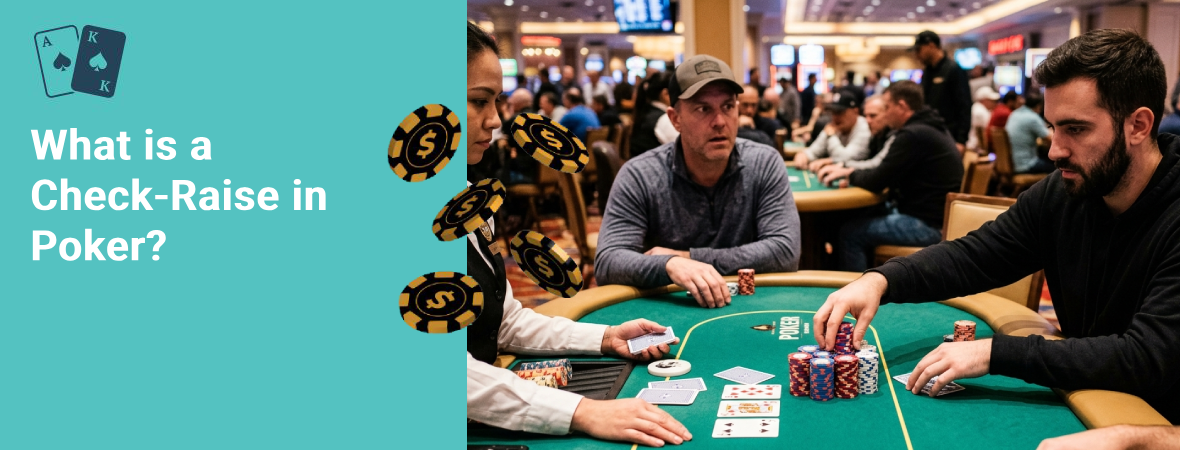
Few moves in poker carry as much “weight”, if you like, as the check-raise. It’s a two-step play, where you initially check – passing on the action – before coming back and re-raising once someone else bets.
Done well, it’s one of the most effective moves you can make at the poker table, while done badly, it tends to show pretty much exactly what you’re holding – and gives your opponents free information.
In this guide, I’m going to explain what a check-raise is, how it actually works, why players use it – and how you can use it without making some common beginner’s mistakes.
Check-Raise: The Basics
A check-raise is basically a two-part action within a single betting round. It means a player checks, declining to bet while keeping their cards live, and then, after another player places a bet, the original player who checked raises the bet rather than simply calling or folding.
A check-raise can only happen when a player acts before at least one other player that’s still in the hand. The idea is to check first if there’s someone still left out behind you. If they bet, the action comes back around to you, and that’s your opportunity to raise.
Here’s a simple example: imagine you’re in the big blind in a No Limit Hold’em cash game. The flop comes down, you check, and a player in late position bets. The action folds back around to you, and instead of calling or folding, you raise. That’s a check-raise – and that’s all there is to it!
Why Players Check-Raise
Check-raises can be used in a number of different situations, and I’ll walk you through a few of the most common ones, below:
Extracting Maximum Value
If you hold a strong hand, for example, and expect an aggressive opponent to bet when checked to, checking first lets them put their money into the pot that they might not have put in if you’d bet yourself first.
You can then raise, either building a bigger pot than a standard bet would have done, or taking a profit right there and then if they fold.
Bluffing and Semi-Bluffing
Checking with a weak or drawing hand, then raising when an opponent bets, applies pressure that a simple bet often doesn’t, while a check-raise can represent real strength: most players don’t check-raise without a real hand.
There’s also a semi-bluff check-raise (with a flush or straight draw), which carries the added benefit of winning the pot outright if the opponent folds – or, if not, improving to the best hand if called, and the draw completes itself.
Controlling Pot Size and Information
Checking first also allows you to gather information before committing any of your own chips to the pot. If your opponent checks behind, you’ve kept the pot small and seen a free card, whereas if they bet, you get to decide whether to raise, call, or fold with the additional knowledge that they chose to bet into you.
Defending Against Aggression
A check-raise can also be used to defend against overly aggressive players. If an opponent is betting most flops regardless of their hand strength, checking and raising can start to put pressure back onto them.
How to Check-Raise
In order to successfully check-raise, two things are required: position, and a player willing to bet after you check. Here’s some other things to be aware of:
Position
In order to be able to check-raise, you need to have at least one opponent still left to act after your check. This usually means you’re in early – or middle – position, relative to the remaining players in the hand – out of position for that betting round.
Players who are last to act (in position) can’t check-raise in the usual sense, because by the time it’s their turn, everybody else has already acted!
Reading the Opponent
A check-raise only works if someone bets after you check, and this means the play depends a lot on your opponents. If you’re playing against someone who checks back most of their marginal hands, then check-raising often fails simply because there’s no bet to actually raise.
Against aggressive players on the other hand – who bet a high percentage of the time – the check-raise becomes a lot more reliable as a value or bluffing tool.
Sizing the Raise
Of course, there is no playbook for how much a check-raise has to be, but most players choose between 2.5x and 3.5x the original bet. It’s very situational, though, and depends a lot depending on the stack depth, pot size, and the message you are actually trying to send
Common Check-Raise Mistakes
Becoming Predictable
If you only ever check-raise with really strong hands, observant opponents will be able to pick up the pattern quickly, especially in online poker where hand histories and tracking software make pattern recognition a lot easier than it is in live play.
Once opponents know that you usually check-raise with a big hand, they simply fold everything except hands that beat you, and you stop getting paid off. The best way to avoid this is to mix in check-raises with bluffs and semi-bluffs and not just premium hands.
Check-Raising Into a Field That Won’t Bet
The play simply doesn’t work if nobody bets before you. Checking with the plan to check-raise against opponents who tend to just check back most of the time just gives away a free card – and can end up losing you value in the long run.
Check-Raising as a Bluff With No Backup Plan
When you make a bluff check-raise with a hand that has absolutely no chance of improving, it’s a high-risk move – because if it’s called, you’re committed to either giving up on the pot later (losing chips) or bluffing into a player who has already shown some degree of willingness to continue.
Generally, it’s more advisable to make semi-bluff check-raises where your hand has a genuine chance to improve, like a flush draw or an open-ended straight draw.
Check-Raising in Different Game Types
Cash Games
When you’re playing in a cash game, chip stacks tend to be pretty consistent between players, and you also have time on your hand – as you often play for many hours at a time.
Check-raises in cash games are often used as a balanced part of a player’s overall strategy, which involves mixing value hands and bluffs to try and remain unpredictable against the same opponents over a long session.
Tournaments
In tournament poker – especially as blinds increase relative to the stack sizes – check-raises tend to carry a lot more weight simply because the chips involved represent a much larger percentage of a player’s remaining stack.
Check-raises in tournaments are, subsequently, often more value-weighted as a result – because the risk of a failed bluff is much higher when you can no longer re-buy.
Online Poker
When you’re playing poker online, hands move a lot faster – and players get to see far more hands per hour than compared to live play. This means patterns start to develop – and get noticed – a lot more quickly.
A lot of online poker players use tracking software, and this means it becomes a lot easier for them to spot check-raise frequencies that are out of balance in a relatively small number of hands. This is an additional hurdle you need to think about, and it’s generally protected against by varying your check-raise range more than you would in a live game.
The Bottom Line
A check-raise is a check followed by a raise within the same betting round, and, for a lot of players, it’s used to try and extract value from strong hands, apply pressure with bluffs and semi-bluffs, get info about a player’s hand before committing chips – and punish players who are overly aggressive.
Like most poker “tools”, the check-raise tends to lose its effectiveness when it’s overused – or used predictably – and the best poker players tend to check-raise with a balanced range of hands, so that opponents can never be entirely sure what they’re facing when the action comes back around to a raise.
Alex Smith is the lead editor and writer at DashTickets, specializing in online casino and sports betting content for New Zealand players. With over 12 years of iGaming experience, including a tenure as Head of Editorial at Casinomeister, Alex is renowned for his accurate, fair, and player-first writing style. His in-depth reviews and guides provide clear, trustworthy information to help readers make confident decisions.
The idea of getting “something for nothing” has always been irresistible to many people – and in the online gambling world, this temptation usually takes the form of no-deposit bonuses. These promotions allow you to start playing without risking a cent of your own money! Now, at first glance no-deposit bonuses can seem like a […]
The inside bet is the name of the wager put on the specific number or numbers. In this case, you make your wager in the center part of the roulette table that includes numbers, not in any of the options like color or even/odd or one of the dozens. The smaller amount of covered numbers […]
If you want to get ahead in blackjack, you must understand blackjack card values. There are lots of casino games that rely just on luck; blackjack is a game that gives players decisions to make based on the cards they hold. Whether you play in a land-based establishment or through an online site, knowing how […]

 Alex Smith